
What the Constraints Made Possible
There is a particular kind of artist who does not fight the rules of their time — and does not surrender to them either.
Adam Elsheimer was one of them.
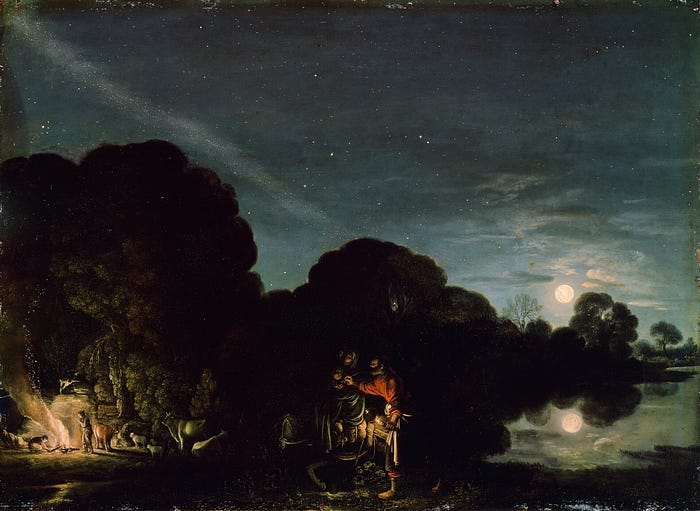
Standing before The Flight into Egypt, painted around 1609 on a copper sheet no larger than a sheet of paper, I find myself looking not at the Holy Family but upward — into a night sky filled with stars, a luminous Milky Way, and at least four distinct sources of light, each casting its own quality of illumination onto the world below.
This is not, in any conventional sense, a religious painting. Or rather, it is a religious painting that has been quietly transformed into something else entirely.
A Painter Working Inside a System He Could Not Ignore
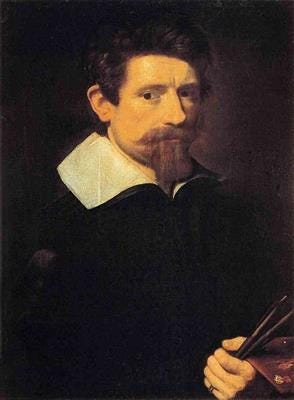
Adam Elsheimer (1578–1610) was born in Frankfurt and spent the final decade of his short life in Rome. He produced only around forty paintings — not from idleness, but from an exacting perfectionism that left him perpetually in debt and eventually imprisoned. He died at thirty-two.
In the Europe of his time, painting operated according to a strict hierarchy. History painting and religious subjects occupied the highest rank. Landscape — however luminous, however technically refined — was considered a minor genre. A painting devoted solely to landscape would not attract serious patronage. It would neither sell nor be recognized as art of consequence.
This was the system within which Elsheimer worked. He could not step outside it. But he found a way to work within it that changed the course of Western painting.
His solution was not confrontation. It was transformation.
Aurora: The Shift Becomes Visible
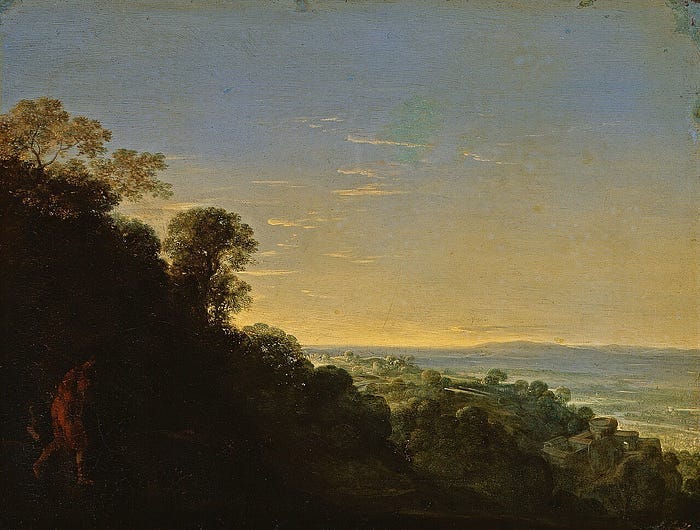
Aurora (c. 1606). Oil on panel, 17 × 22.5 cm. Herzog Anton Ulrich Museum, Braunschweig.
In 1606, Elsheimer produced a small panel depicting the gradual spread of dawn across the sky.
The narrative component is minimal. A mythological figure is present, but barely. What the painting is actually about is light: the precise, almost scientific observation of how illumination spreads from a single point along the horizon, transforming the sky in gradations of color that no earlier painter had rendered with such attention.
At a time when landscape was considered a minor genre, this constitutes a clear and deliberate shift. Elsheimer had found a way to make the light itself the subject — while maintaining the formal structure of a mythological painting.
But he was not finished. He turned next toward a more difficult problem: not the light of dawn, but the light within darkness.
The Flight into Egypt: A Total System of Light
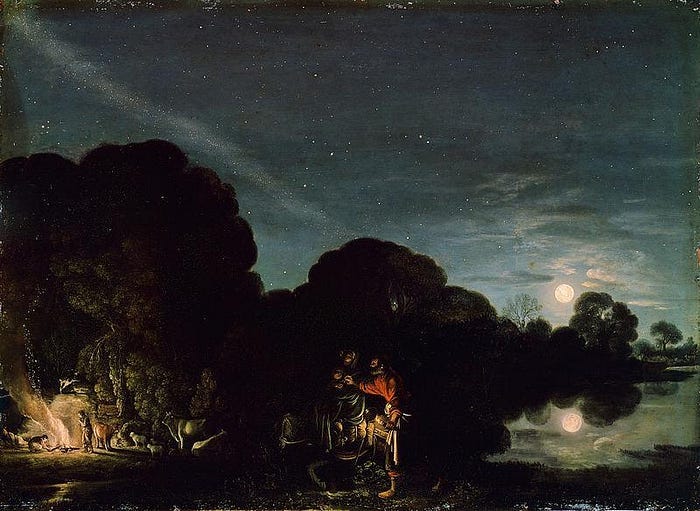
The Flight into Egypt (c. 1609). Oil on copper, 31 × 41 cm. Alte Pinakothek, Munich.
The Flight into Egypt is, on its surface, a New Testament subject — the Holy Family fleeing the persecution of King Herod. It is painted on copper, a surface that allows for extraordinary precision and luminosity.
What Elsheimer constructs within this religious framework is something that had never been attempted before: a complete nocturnal light system.
Four sources of illumination are present simultaneously, each distinct in quality and character. The moon casts a cool, silver reflection on the water. The Milky Way — rendered as a dense field of individual stars — spreads across the upper sky with an accuracy that places this among the earliest astronomically observed night skies in Western painting, contemporary with the telescopic observations of Galileo. Joseph carries a torch whose warm, concentrated light falls directly on Mary and the Christ child. In the middle distance, shepherds are gathered around a fire, its glow diffuse and amber.
Each light source obeys its own logic. Each illuminates differently. And yet the painting holds together as a unified nocturnal world.
Within a religious framework, Elsheimer had constructed what he could not have constructed within landscape painting alone: a total, cosmological vision of light.
AI Comparative Analysis: What If Elsheimer Had Painted Only the Landscape?
Using generative AI, I constructed a variant of The Flight into Egypt in which all human figures were removed, leaving only the landscape and its system of light.
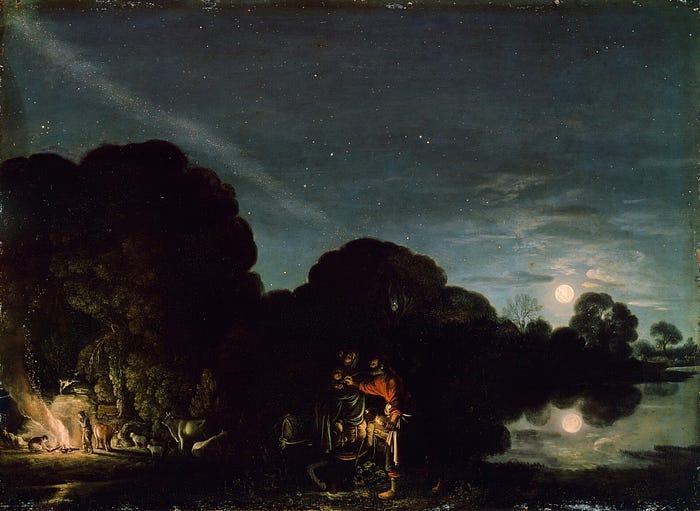
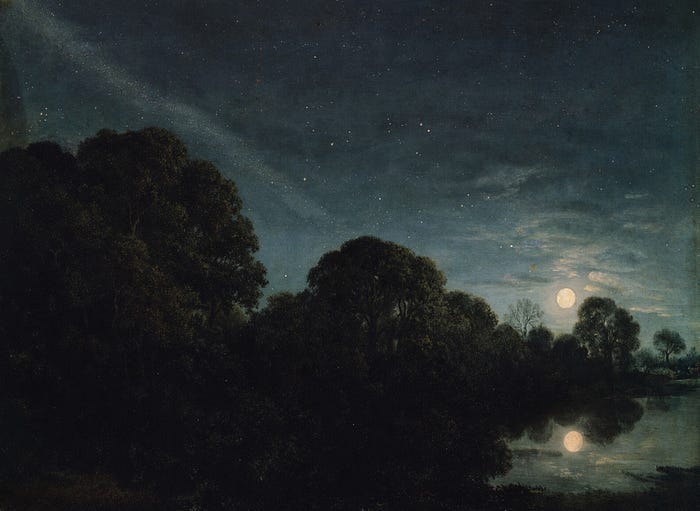
The result is visually coherent. The night sky retains its luminosity. The Milky Way remains. The moonlight still falls on the water.
But something essential has changed.
The small human figures in the foreground — Joseph’s torch, Mary on the donkey, the shepherds around their fire — establish a scale. They give the viewer a reference point against which the immensity of the night sky becomes legible. Remove them, and the sky remains vast; but its vastness no longer registers with the same force, because there is nothing human against which to measure it.
What appeared to be a constraint — the inclusion of religious figures required by the genre — proves to be a structural necessity. The limitation produced the solution.
This is what the AI comparison makes visible: not what was lost when figures were removed, but what the figures were actually doing in the painting all along.
Conclusion: The Third Method
Elsheimer neither submitted to the hierarchy of genres nor rejected it outright.
He found a third method.
Religious painting became a structural framework within which light could be developed beyond the limits that landscape painting, as a minor genre, could not support. The constraint did not disappear; it was absorbed, reconfigured, and put to work.
Four centuries later, standing before a copper panel small enough to hold in both hands, what remains is the night sky — and the quiet sense that the man who painted it was looking at something larger than any single genre of painting could contain.
He simply found a way to paint it anyway.