Painters of Light : Frederic Edwin Church — Artificial Light in Nature

The Light That Looks Like It Belongs
Standing before a painting by Frederic Edwin Church, you feel something that neither Impressionism nor Baroque quite produces.
The rocks are rocks. The water is water. The trees are trees — each leaf rendered with a precision that speaks of direct observation in the field. And yet the light that runs through all of it carries an intensity you have never seen in nature. It looks completely natural. It looks like it belongs exactly where it is.
It doesn’t.
Church constructed his light. He borrowed phenomena from other latitudes, transplanted them into landscapes where they could not meteorologically exist, and painted them with such conviction that the artifice disappears entirely. The result is light that feels more natural than nature — because it has been designed to.
A Painter Who Traveled to the Edges of the World
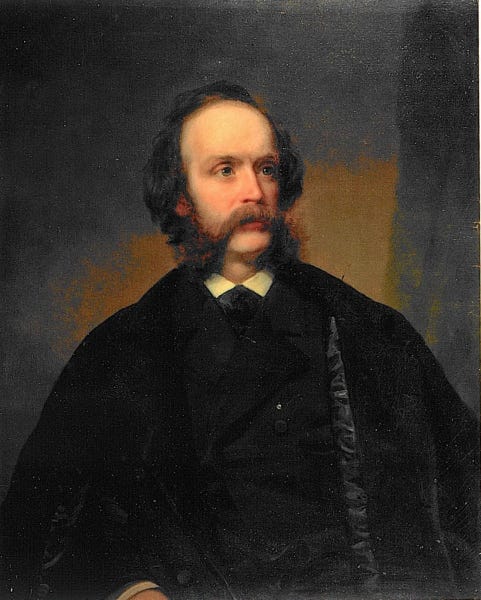
Frederic Edwin Church (1826–1900) was born in Hartford, Connecticut, into a prosperous family. At eighteen, he became the pupil of Thomas Cole — the founding figure of American landscape painting — and within two years had been recognized as his most gifted student.
But Church was not satisfied with the gentle hills of New England that had defined his teacher’s world. What he sought was nature on a scale that exceeded human imagination — places where God’s presence still felt immediate and undeniable.
He traveled twice to Ecuador and Colombia, in 1853 and 1857, inspired by the explorer Alexander von Humboldt’s Cosmos. He sailed to the icebergs off Newfoundland. He journeyed to Jerusalem, Athens, and Rome. In the 1870s, he designed and built a Persian-style mansion — Olana — on a bluff above the Hudson River, conceiving the surrounding landscape itself as a work of art.
The age Church lived in was one of profound disruption. Darwin’s On the Origin of Species (1859) had unsettled the idea of divine creation. In Paris, the Impressionists were declaring that painting’s purpose was the capture of fleeting sensation — not truth, but experience.
America breathed a different air. The Transcendentalists — Emerson, Thoreau — had established as intellectual bedrock the idea that God inhabits nature directly. For Church, the wilderness was not a place to escape to. It was the place where the divine was still visible. His light was not beautiful scenery. It was theology made visible — and deliberately intensified to make that theology legible.
The Phenomenon That Could Not Have Existed
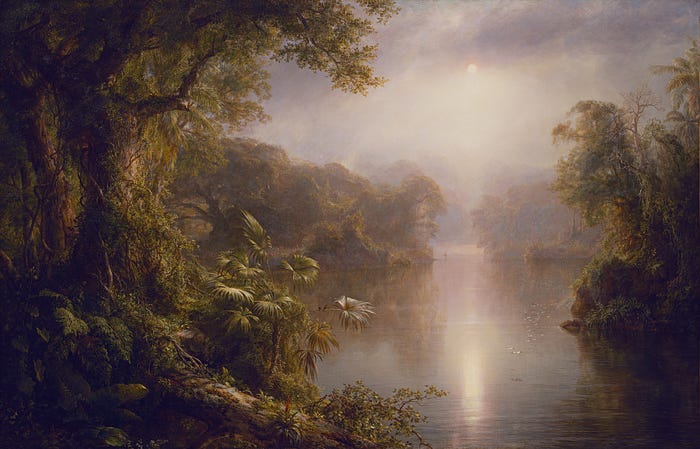
El Río de Luz (The River of Light), 1877. Oil on canvas. The Metropolitan Museum of Art, New York.
This painting of the Amazon at dawn is where Church’s exaggeration reaches its most precise and deliberate form.
The morning sun has just begun to rise, and its reflection runs the length of the river — not as a shimmer, but as a vertical column of light that descends into the water and ascends into the sky along the same axis. This symmetrical shaft resembles a natural phenomenon known as a sun pillar: the reflection of sunlight off hexagonal ice crystals suspended in the atmosphere.
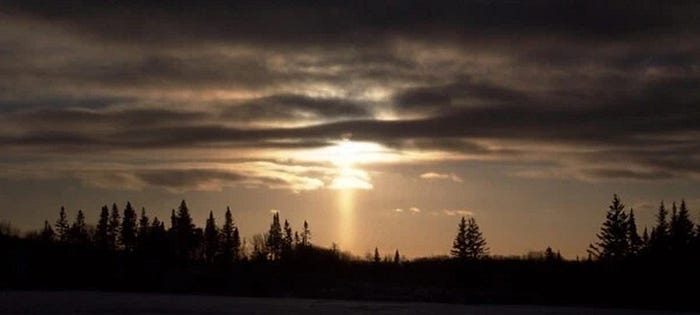
Sun pillar (photograph)
But sun pillars do not occur in the tropics. The Amazon’s warm, humid air produces no atmospheric ice crystals. What Church painted here was not observed. It was invented — a phenomenon transplanted from the arctic into the equatorial rainforest, because it expressed something he needed the painting to say: that light is not merely present in the world, but active and sacred within it.
The surrounding rainforest is painted with meticulous accuracy. Individual leaves, distant mountain silhouettes, the surface texture of the water — everything accumulated from field sketches made on location. This precision is not documentary instinct. It is the ground against which the exaggeration becomes legible. The more convincingly real the world appears, the more powerfully the impossible light column asserts itself as something beyond nature. Realism was the instrument through which exaggeration could work.
Two Kinds of Exaggerated Light
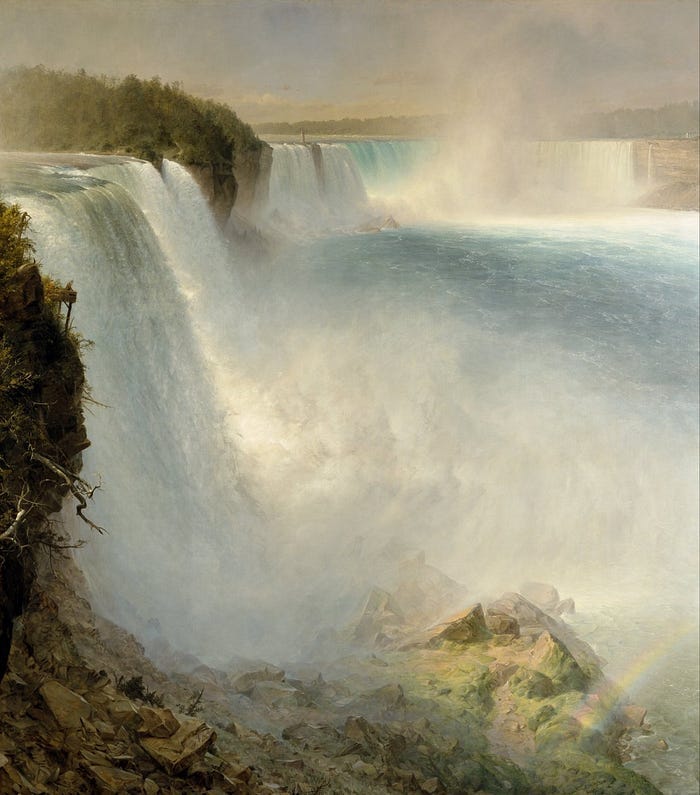
Niagara Falls, from the American Side, 1867. Oil on canvas. Scottish National Gallery, Edinburgh.
A critic once wrote that viewers instinctively stepped backward when they first encountered this painting.
Two-thirds of the canvas is occupied by white water — not the blue-green of conventional waterfall paintings, but a dense, light-saturated white that reads as force rather than liquid. Church placed the viewer at the very edge of the falls, eliminating the safe distance that landscape painting traditionally maintained. The mist serves as a diffusion medium for light. At the lower right, almost too small to notice, a rainbow appears in the spray — Church’s quiet signature that the exaggeration is grounded in natural law, even as it exceeds it.
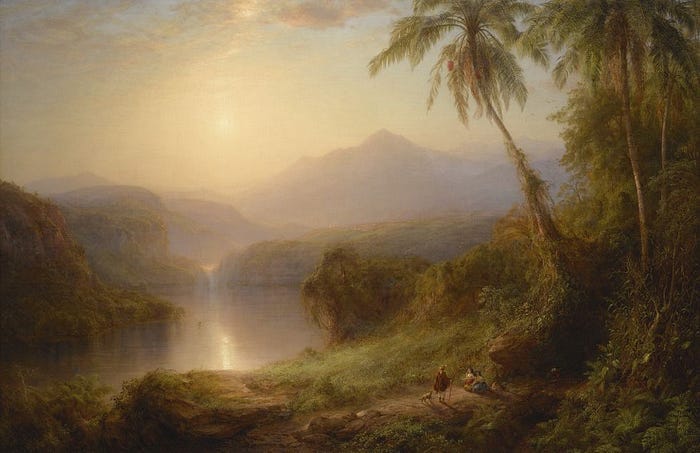
Valley of Santa Isabel, New Granada, 1875. Oil on canvas. Private collection.
If Niagara exaggerates light as overwhelming force, this Colombian valley exaggerates it as quiet benediction.
The late sun trails its reflection along the water and edges the mountain silhouettes in gold. Small figures of travelers appear on the path — not as subjects, but as scale. They exist to make the surrounding light legible as something that dwarfs and encompasses human presence. Here the exaggeration is gentle, but no less deliberate.
Freedom from constrain
Church never became an Impressionist, and never became Turner.
He remained committed to the proposition that the world — in its full, observable, geological, botanical specificity — was the necessary ground from which exaggerated light could derive its force.
Four centuries before him, Elsheimer had concealed his pursuit of light within the structure of religious painting. Church had no such constraints. He worked in a country that still believed the landscape was sacred, for an audience that had not yet been taught to doubt it.
He used that freedom not to dissolve the world, but to fill it — leaf by leaf, river by river — with a light that nature itself could not quite produce.
AI Comparative Analysis: What If the Exaggeration Were Removed?
Some critics have noted a resemblance between Church and Turner. The comparison is worth testing directly — because it reveals precisely what Church’s exaggeration was doing.
Using generative AI, I converted El Río de Luz into a Turner-style variation, applying the atmospheric dissolution characteristic of Turner’s late work.
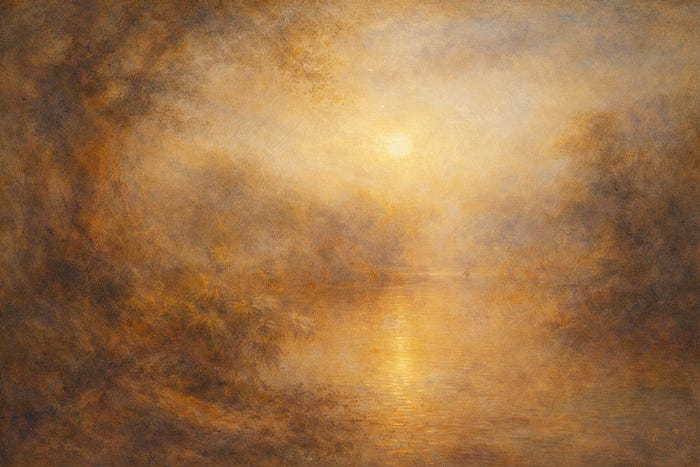
The moment Turner’s method is applied, the individual leaves of the rainforest dissolve into haze. The light column loses its definition. The Amazon ceases to be the Amazon. There is only golden atmosphere.
This is precisely what Turner intended. For Turner, form was expendable. If depicting light required the dissolution of everything else, that was not a loss — it was an advance toward the essential.
Church’s exaggeration operated in the opposite direction. He pushed light beyond nature while keeping the world intact — because the world was the argument. A real Amazon had to exist in order for the impossible light column to register as something beyond the real. Without the leaves, the light has nothing to exceed.
Turner exaggerated by dissolving the world into light. Church exaggerated by driving light into the world until it could no longer be contained by it.