
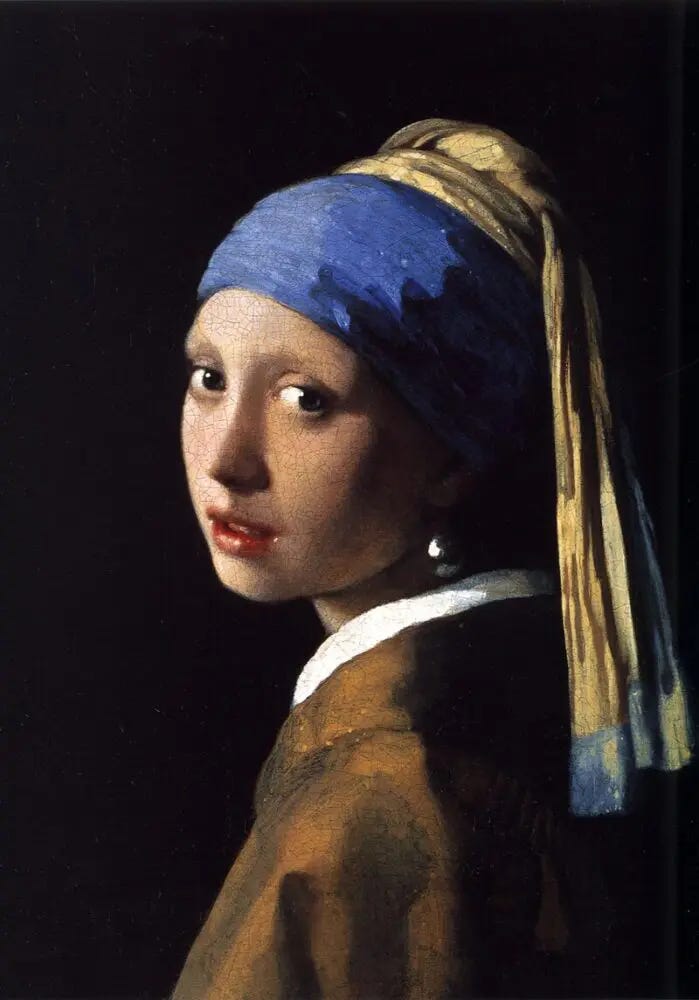
A Mystery Western Art History Has Not Yet Addressed
Before a painting by Johannes Vermeer, we see light first.
The cold daylight entering through the window. The soft shadows falling across a table. The reflection sliding along the surface of fabric. All of it rendered with a precision that seems to belong to a lens rather than a brush. Recent research has confirmed what many observers have long sensed: Vermeer was deliberately painting the optical effects of lens bokeh and halation with paint.
But there is a mystery in Vermeer’s light that Western art history has not yet fully addressed. The clue to that mystery came, unexpectedly, from a characteristic unique to the Japanese.
Johannes Vermeer: Thirty-Four Paintings, Forty-Three Years
Johannes Vermeer (1632–1675) was born in Delft, in the Dutch Republic. His father ran an inn and dealt in paintings, and Vermeer grew up within that world. At twenty-one he obtained his master’s qualification from the painters’ guild, and he spent virtually his entire life in Delft.
Only 34 paintings survive. Though respected during his lifetime, his output was extraordinarily slow — two or three works a year at most, in sharp contrast to Rembrandt, who left hundreds. He left eleven children and died in financial difficulty at forty-three, and was largely forgotten for nearly two centuries after his death.
In the nineteenth century he was rediscovered. The French critic Théophile Thoré-Bürger called him “the Sphinx of Delft” and reintroduced him to the world. Whether Vermeer used a camera obscura as a compositional aid remains debated. What is certain is this: he observed the quality of light with a precision unmatched by any painter of his era.
How Vermeer Staged Light
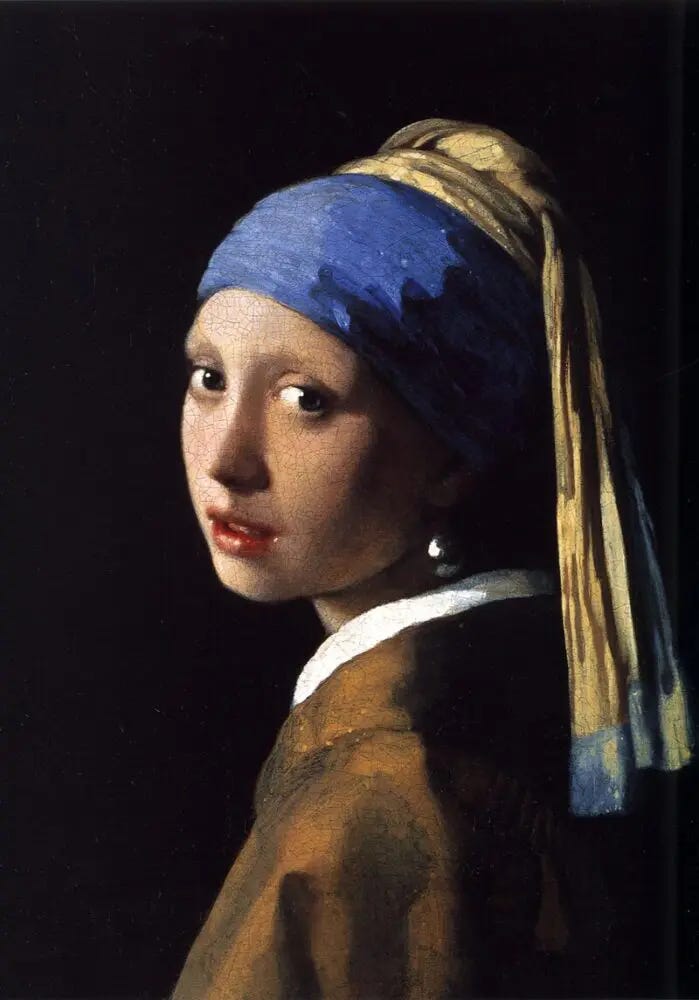
Girl with a Pearl Earring (c. 1665). Oil on canvas, 44.5 × 39 cm. Mauritshuis, The Hague.
The light enters from the left, slightly behind the horizontal. Because the girl has turned toward the viewer, the light grazes her left temple and cheekbone before shadow deepens across the right cheek, jaw, and neck. Highlight on the left, shadow falling toward the right — this angle pulls the face three-dimensionally from the black ground behind her.
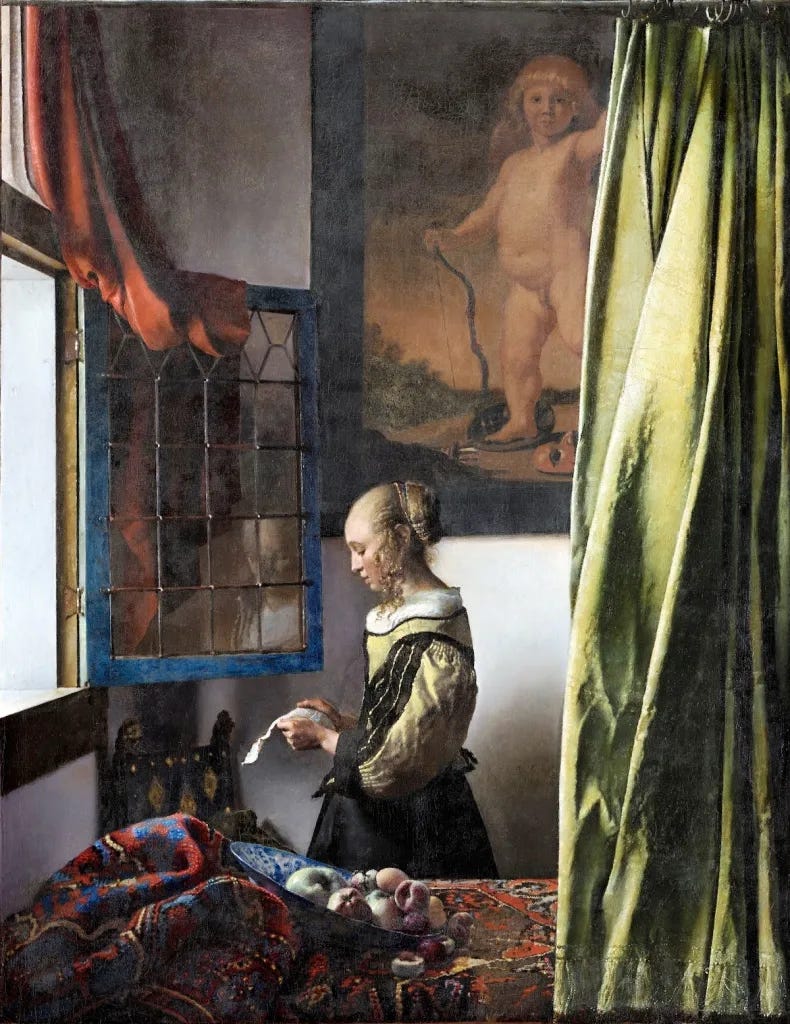
Woman Reading a Letter (c. 1657–1659). Oil on canvas, 83 × 64.5 cm. Gemäldegalerie Alte Meister, Dresden.
In Vermeer’s interior paintings, the window is invariably on the left side of the composition. The standard explanation is practical: a right-handed painter keeps the light source on the left to avoid casting his brush hand across the canvas. This is reasonable. But I do not think it is sufficient.
Western writing moves from left to right. This directionality operates unconsciously when we look at images as well. When Vermeer places light on the left, the viewer’s gaze travels naturally with the light — left toward right — coinciding exactly with the movement the brain already makes when reading.
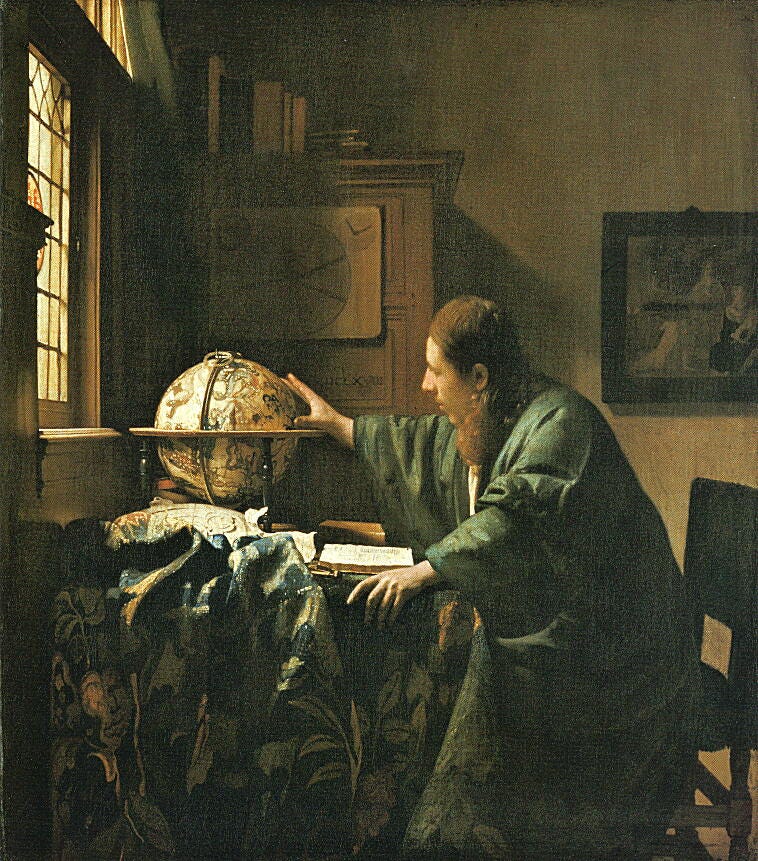
The Astronomer (c. 1668). Oil on canvas, 51 × 45 cm. Musée du Louvre, Paris.
Across all of Vermeer’s surviving interiors, the structure holds without exception: window on the left, figure positioned closer to the viewer than to the window. The result is always a slight contre-jour — the front of the figure falls into shadow, the three-dimensional outline is thrown into relief. In thirty-four paintings, this composition does not waver.
AI Comparative Analysis: What if Light flipped?
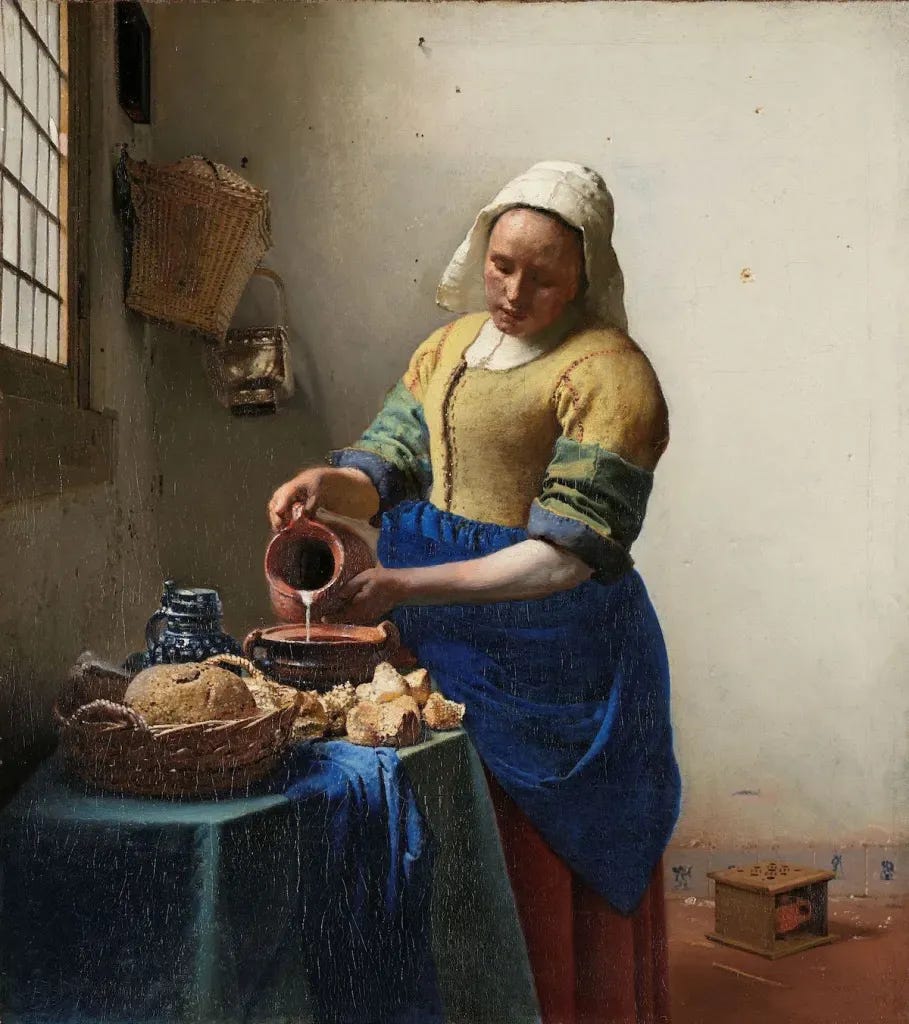
The Milkmaid (c. 1657–1658). Oil on canvas, 45.5 × 41 cm. Rijksmuseum, Amsterdam.
I mirrored The Milkmaid horizontally. If reading direction plays no role in how we experience a painting, reversing it should produce no significant effect — we would simply register that the light now enters from the right.
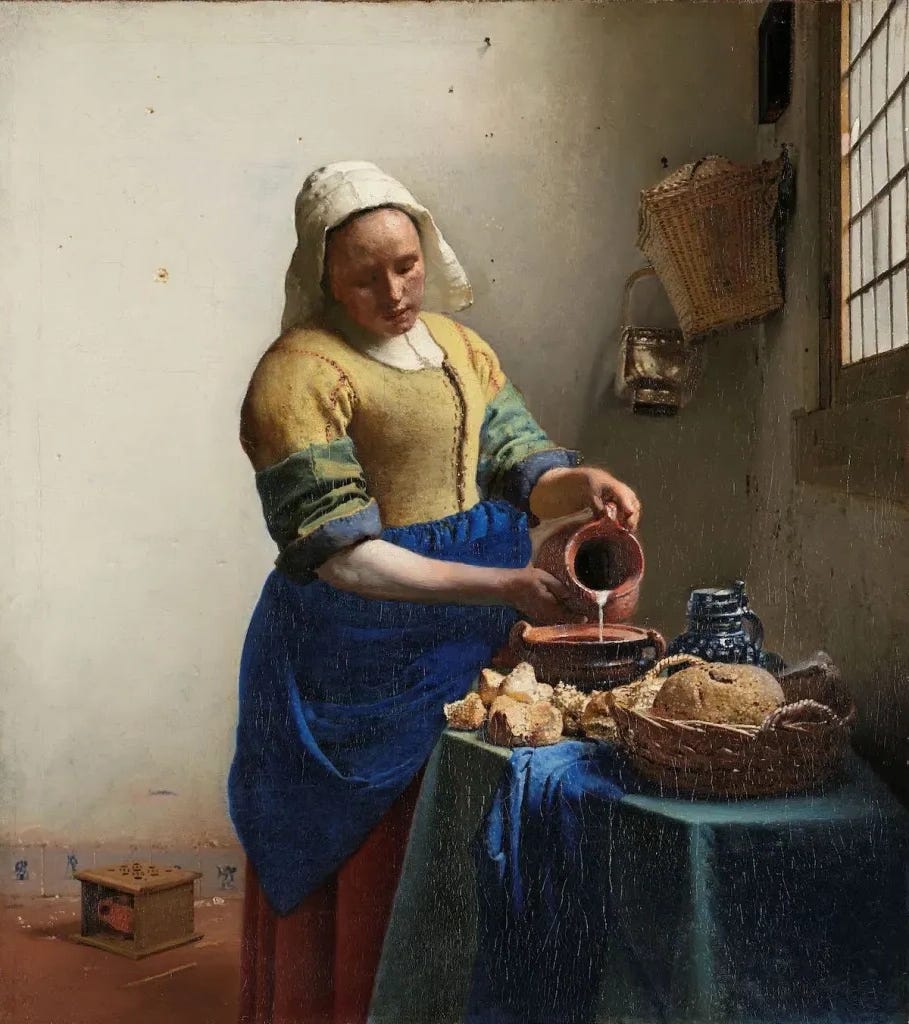
The Milkmaid — Horizontally Mirrored: Discomfort Appears.
The mirrored image produces immediate discomfort. The logic of light and the action of the figure are theoretically unchanged, but the painting feels wrong — like handwriting produced by the non-dominant hand. Stability has gone. In its place, a wavering quality: the light is now moving right to left, against the natural direction of the eye, and the brain registers the friction.
Then I placed a vertical Japanese text over the mirrored image.
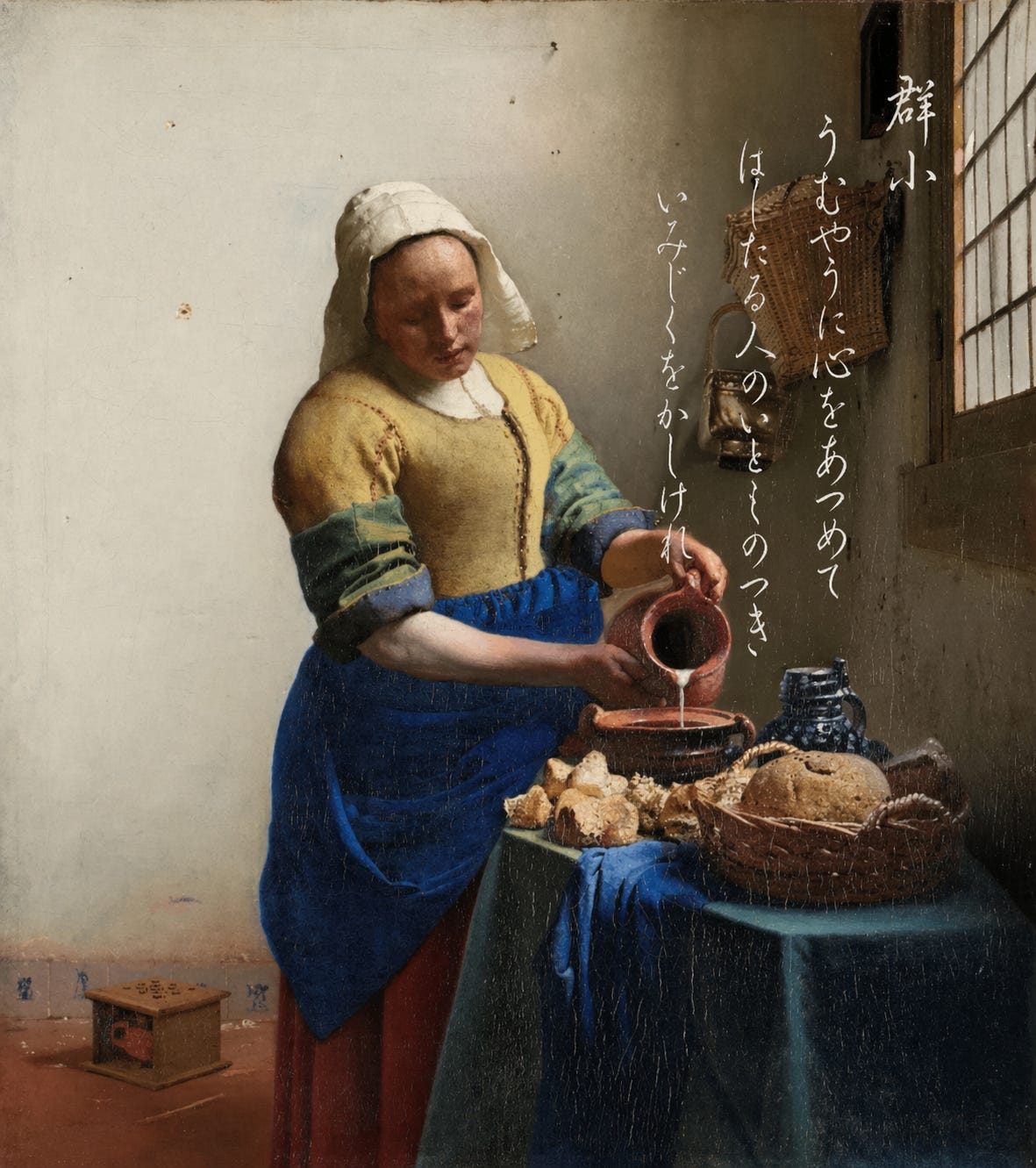
The Milkmaid — Mirrored with Vertical Japanese Calligraphy: Discomfort Dissolves.
A brief note for readers unfamiliar with Japanese writing. Japanese has historically been written vertically, moving from right to left. With Westernization in the modern era, horizontal left-to-right writing was adopted alongside the vertical form. Today both coexist in daily life: novels and newspapers often use vertical text, while digital communication and most signage use horizontal. A literate Japanese person reads in both directions as a matter of course — the brain switches between the two scanning modes without conscious effort.
The discomfort dissolves immediately. Under vertical reading direction, the right side becomes the beginning and the left becomes the arrival. The light entering from the right now travels in the same direction as the scanning eye. When “reading direction” and “light direction” synchronize, the painting becomes natural once more.
AI Comparative Analysis continued: With Two Other Languages.
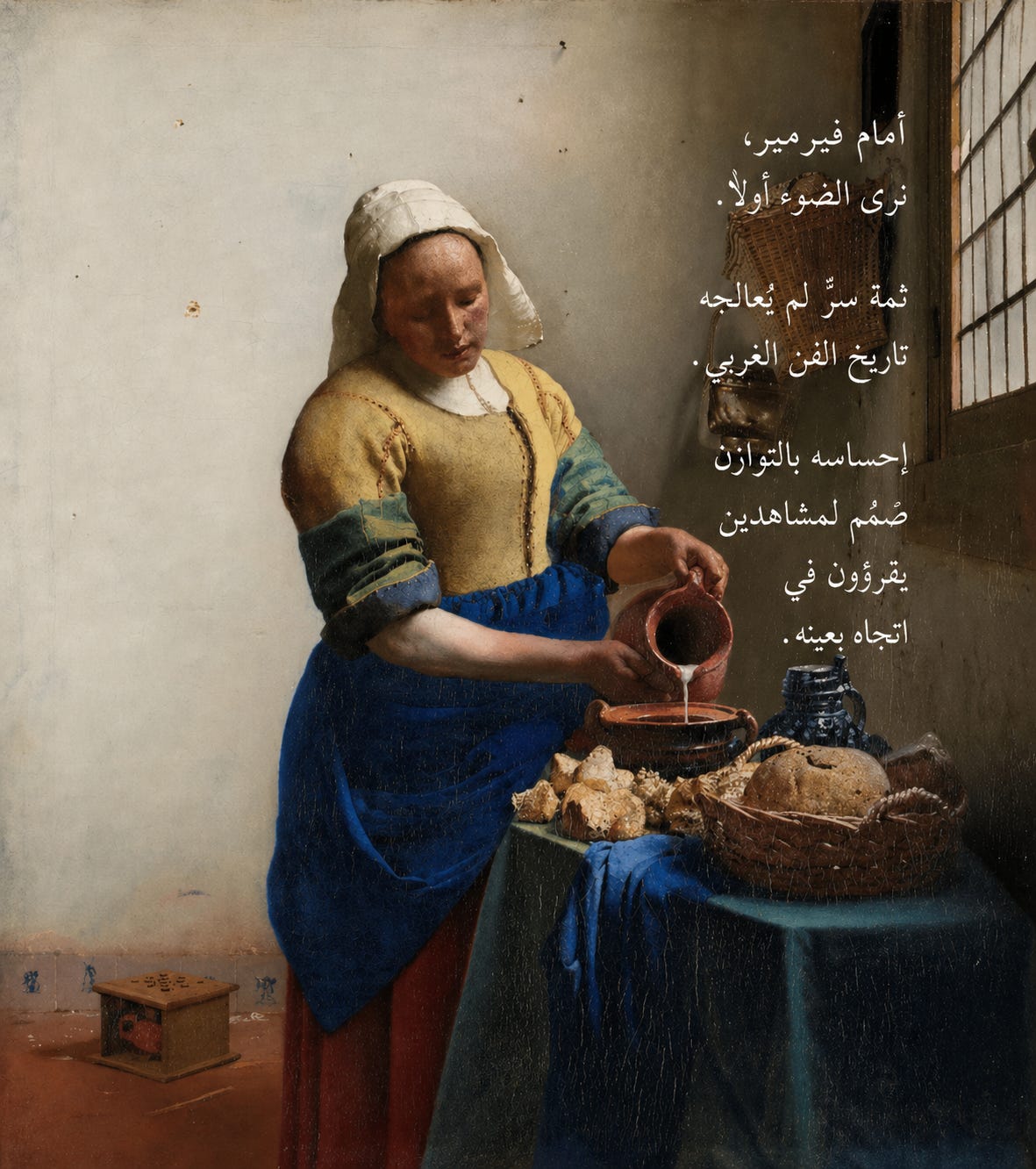
Arabic is read from right to left — the same direction as the mirrored Vermeer. For an Arabic reader, the light entering from the right is the light that arrives first.
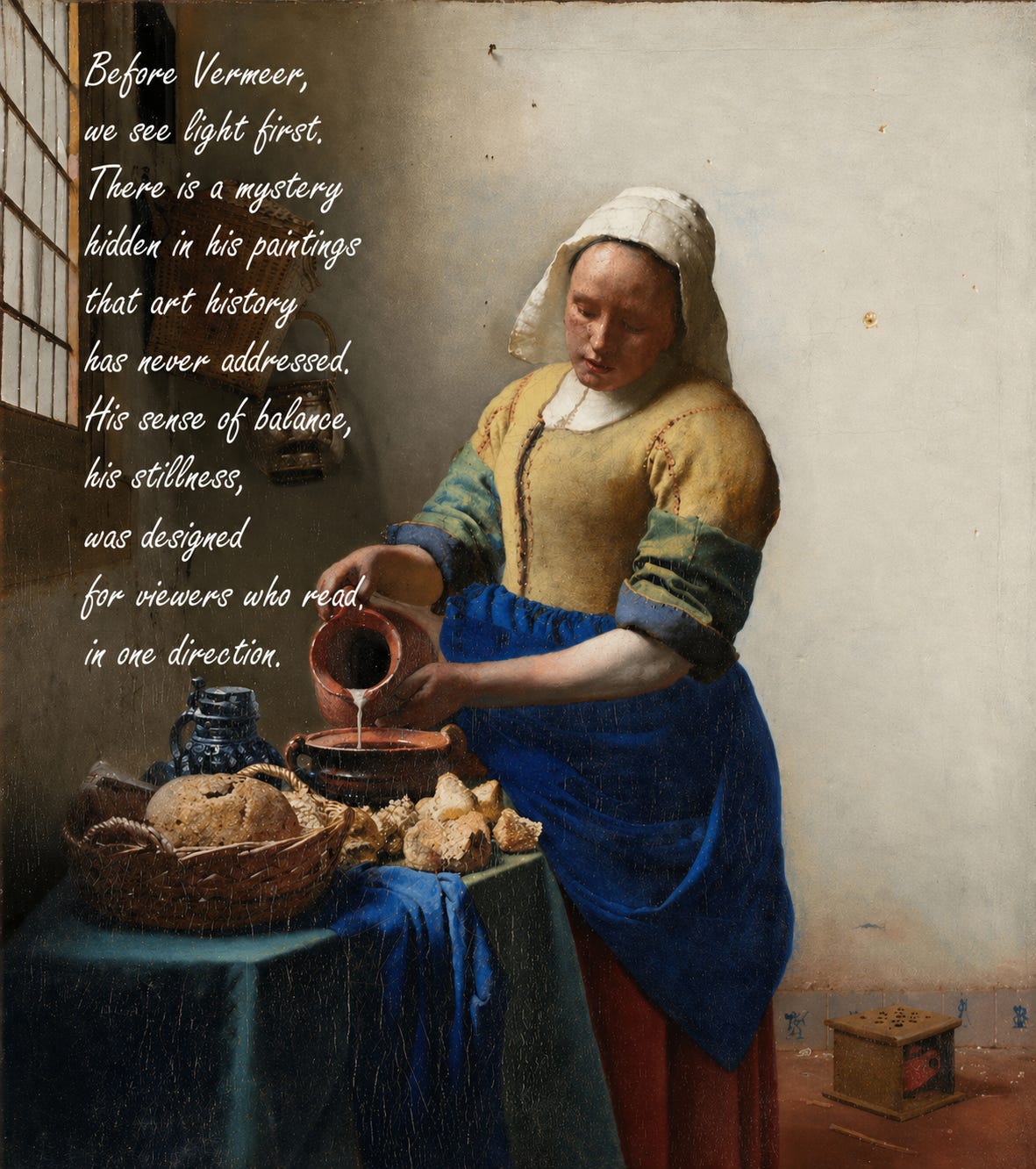
English is read from left to right — the same direction as the original. For an English reader, the window on the left is simply where light comes from.
Three languages. Three scanning directions. The same painting, experienced three different ways.
The Brain’s “Following Light” and “Against Light”
That the discomfort disappears when vertical writing is introduced means that, until that moment, we had been reading the space unconsciously from left to right. The capacity to experience both the appearance and the disappearance of that discomfort belongs, perhaps, to Japanese readers — and this is not accidental. Japanese readers are natural switch-hitters.
Western readers always experience left-side light as following.
Arabic readers always experience right-side light as following. Neither can switch.
Japanese readers switch between left-side light and right-side light as following
The brain has learned two scanning directions — and can move between them. This means a Japanese viewer can experience Vermeer’s light as following in one mode, and as against light in the other.
However, Arabic speakers read Arabic numerals from left to right. The capacity for directional switching may not belong to Japanese readers alone.
The Research That Supports the Hypothesis
This hypothesis has a basis in cognitive science.
Smith, Szelest, Friedrich & Elias (2015), “Native reading direction influences lateral biases in the perception of shape from shading,” Laterality, University of Saskatchewan. Using eye-tracking, the study demonstrated that left-to-right readers process light from the upper left more readily, while right-to-left readers process light from the upper right more readily.
A related earlier study — Smith & Elias (2013) — confirmed that left-to-right readers show a significant preference for left-lit images, while right-to-left readers prefer right-lit images.
The experiments themselves are simpler than the Vermeer scenario. But their findings are fully consistent with the discomfort revealed by the mirror test, the resolution of that discomfort when vertical writing is introduced, and the possibility that this resolution is specifically available to Japanese readers.
The Window Was Never Simply About the Brush Hand
Vermeer left thirty-four paintings. In each, light is adjusted with millimeter precision — the angle of entry, the fall of shadow, the degree to which the figure is set against its source.
The position of the window on the left has been discussed by art historians for generations. Hidden within that “obvious” fact—for the ease of use by right handed artist , however, was an unconscious assumption belonging to Western writing culture. If the language-governing brain operates when we view paintings, then Vermeer’s sense of stability was designed for viewers with a specific scanning direction.
The window in Vermeer’s paintings is always on the left not because a right-handed painter needed to keep his brush hand clear of shadow, but because aligning the direction of Western reading with the direction of light creates the condition in which a viewer receives the painting as given rather than imposed — as a room entered, not a picture examined. Vermeer knew this intuitively. Thirty-four paintings are the evidence.