
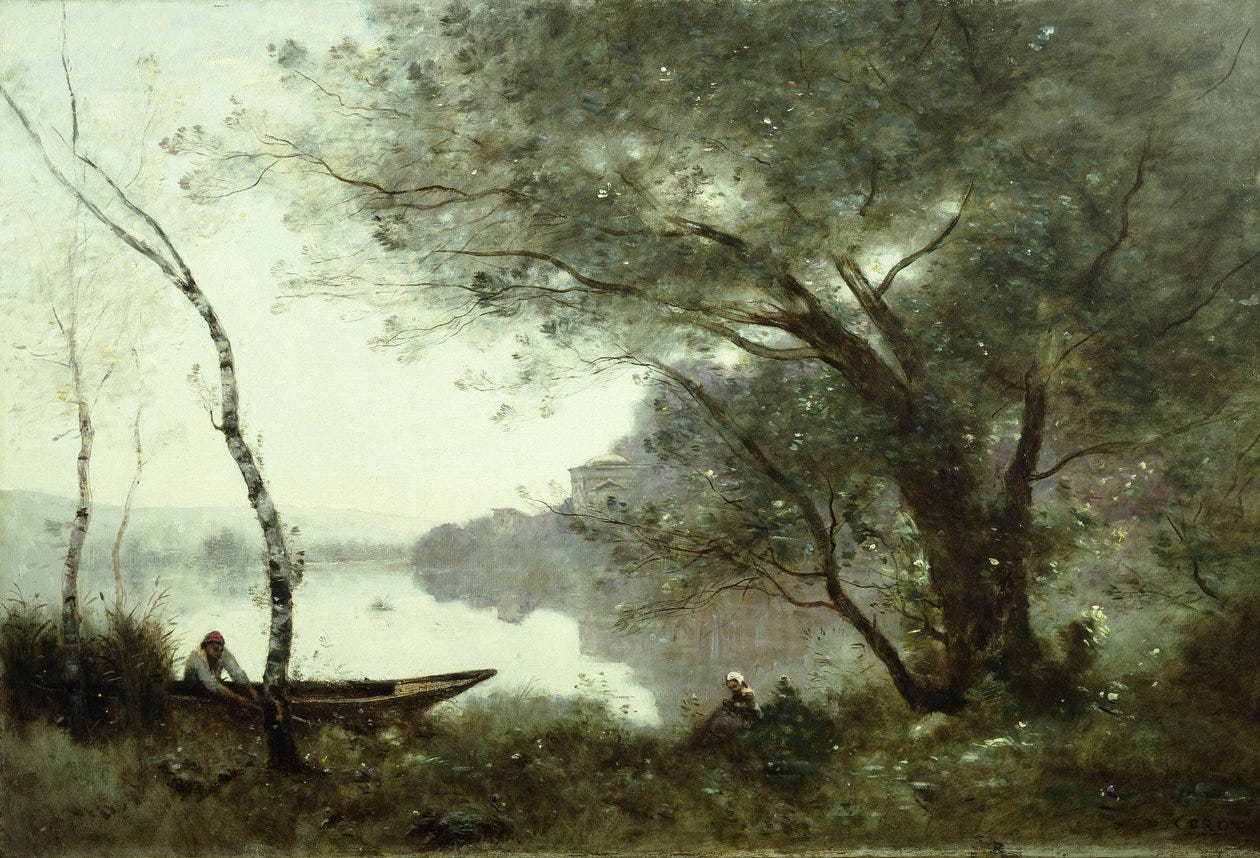
“What a beautiful painting. Yes — refined, elegant.”
That is the honest response one painter arrived at after standing before Corot’s work for many years.
This is not a criticism. Corot is undeniably the supreme master of painting that never leaves its comfort zone. But that peak has a ceiling. Turner dissolved form itself in pursuit of the essence of light. Friedrich ignored the mainstream of his era entirely, choosing a minimal silence. Church painted columns of light that could not exist in nature. Painting that steps outside the comfort zone can never be surpassed by painting that stays within it.
Let us consider why — standing before Corot’s work.
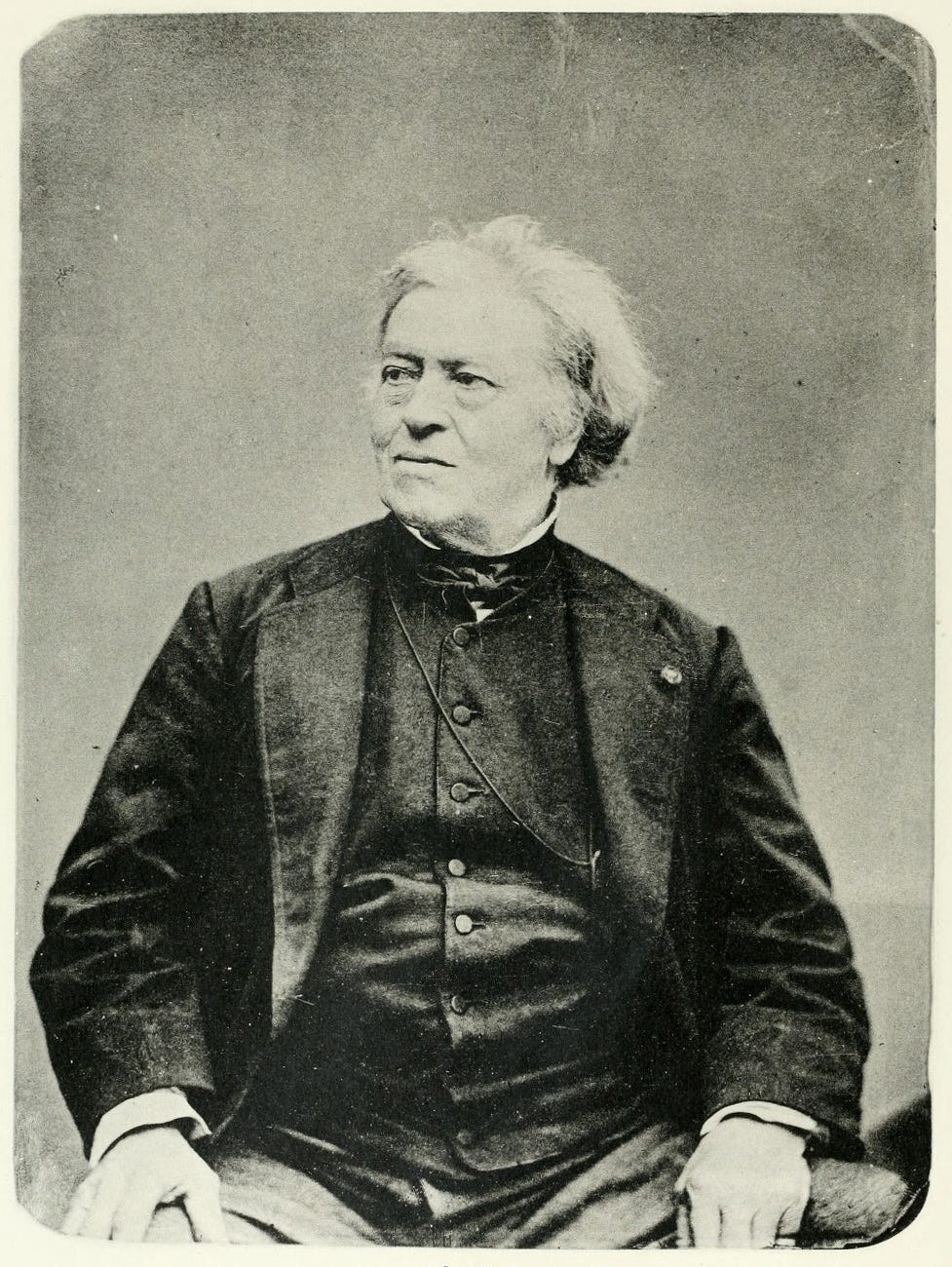
The Perfecter of Painting That Stays Within the Comfort Zone
Jean-Baptiste-Camille Corot (1796–1875) was born in Paris into the family of a prosperous cloth merchant. His father opposed his son’s wish to become a painter, but eventually relented and continued to support him financially. Within that economic security, Corot painted at his own pace, without urgency.
In the village of Barbizon, adjacent to the Forest of Fontainebleau southeast of Paris, a group of painters gathered — Corot, Millet, Théodore Rousseau, Daubigny, Troyon, and others, known as the “Seven Stars of Barbizon.” Based at the inn of Père and Mère Ganne, they set their canvases directly in nature and painted the landscape as it was. In an era when history painting and mythology held the highest rank, this was a movement that established landscape itself as a legitimate subject.
Corot, however, never settled permanently in Barbizon. He moved between Paris, Ville-d’Avray, and various other locations, maintaining a degree of independence even while staying in close contact with the Barbizon circle. He mentored the young Pissarro and served as a bridge toward Impressionism.
There is a famous irony surrounding Corot: “Corot painted 3,000 works in his lifetime, and 10,000 of them are in America.” The sheer proliferation of imitations and forgeries is itself a testament to how high the demand was for his paintings — precisely because they were beautiful in a way anyone could understand.
Corot and Friedrich lived in the same era. Friedrich was born in 1774, Corot in 1796 — a gap of twenty-two years. Corot was forty-four when Friedrich died in 1840. That two painters of such diametrically opposed aesthetics existed at the same moment in history is, on reflection, remarkable.
Never Challenging Touch
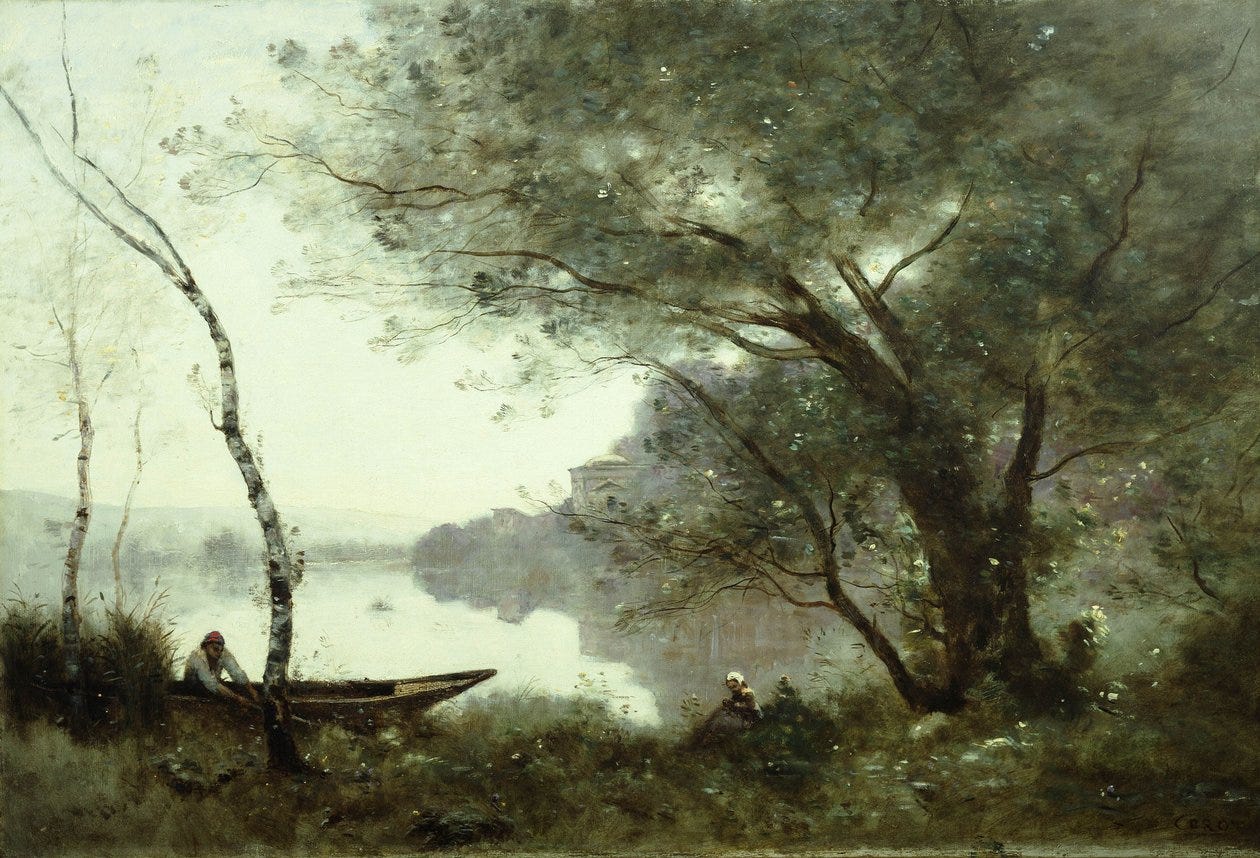
Le Batelier de Mortefontaine (The Boatman of Mortefontaine), c.1865. Oil on canvas. Musée du Louvre, Paris.
This work depicts the surface of a lake near the village of Mortefontaine in northern France. The boat moored at the bank draws the eye as a focal point, but the true subject is the lake and sky. Both are rendered in an almost uniform tone, and the boundary between water and air dissolves so gently that the entire scene reads as a screen filled with light.
Here again, light is a condition. Morning light saturates the atmosphere — nothing more. The light has no direction, no emphasis, no argument. It is a stillness close to that of nirvana.
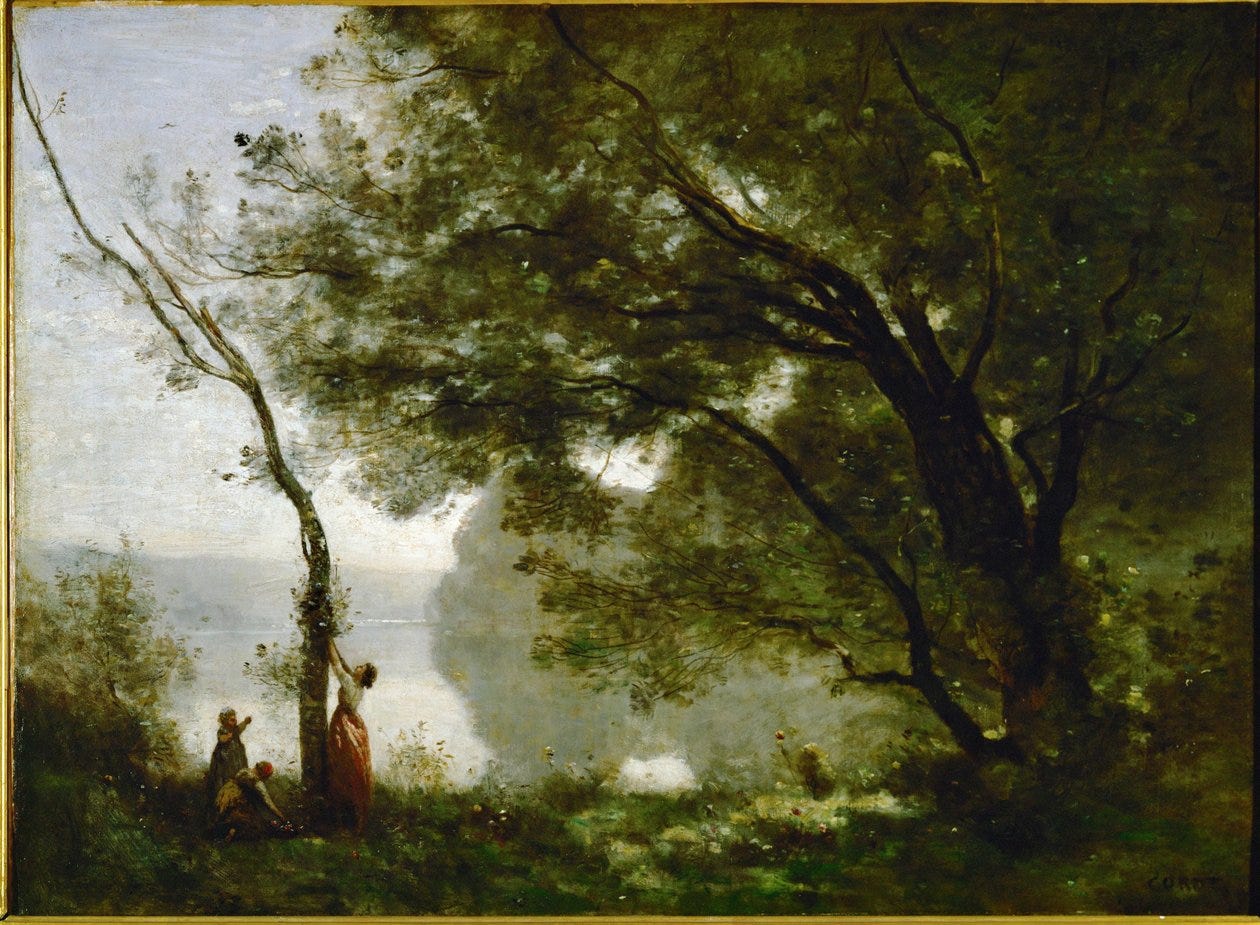
Souvenir de Mortefontaine (Memory of Mortefontaine), 1864. Oil on canvas. Musée du Louvre, Paris.
Painted the year before at the same location, this is considered one of Corot’s greatest masterpieces. The composition moves closer and grows bolder; the contrast is higher, the figures more animated. It carries more force than The Boatman.
Yet for all that force, the nature of the light does not change. The air is in a state of brightness — nothing more, nothing less. Between these two works, Corot painted the same light-as-condition from a slightly different angle, and nothing else.
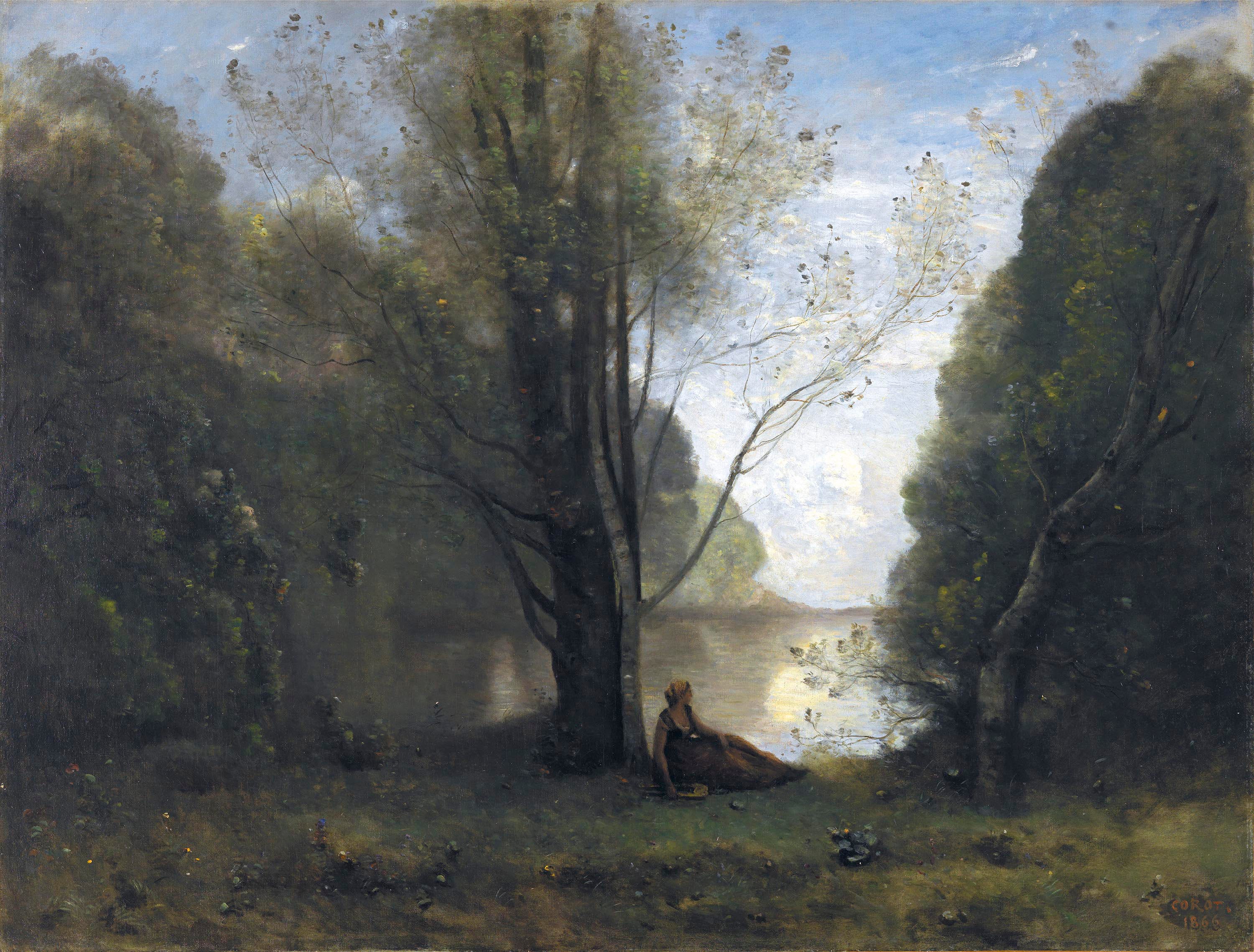
The Solitude. Recollection of Vigen, Limousin, 1866. Oil on canvas. 95 × 130 cm. Museo Nacional Thyssen-Bornemisza, Madrid.
Through the trees, a river is visible. Before it sits a solitary woman. She is not the subject of this painting. She is a staffage figure.
For the Barbizon painters, the staffage figure was something entirely different from the figures of the history-painting era — those characters who existed as pretexts for narrative. The staffage simply is there, without interrupting nature’s role as protagonist. Corot’s figures are this above all: they hold no dramatic relationship with light, conduct no emotional dialogue with the landscape. They are placed within nature, and that is all.
Look at the handling of light. There is no identifiable light source. The air is uniformly bright. Light does not fall — the air is simply in a state of brightness. The light has no direction, no emphasis, no argument. This is the essence of Corot’s light: light as condition. Light that stays within the comfort zone.
Napoleon III purchased this painting for 18,000 francs as a gift for Empress Eugénie de Montijo — an extraordinary sum for the time. That painting within the comfort zone is favored by those in power has never changed across the centuries.
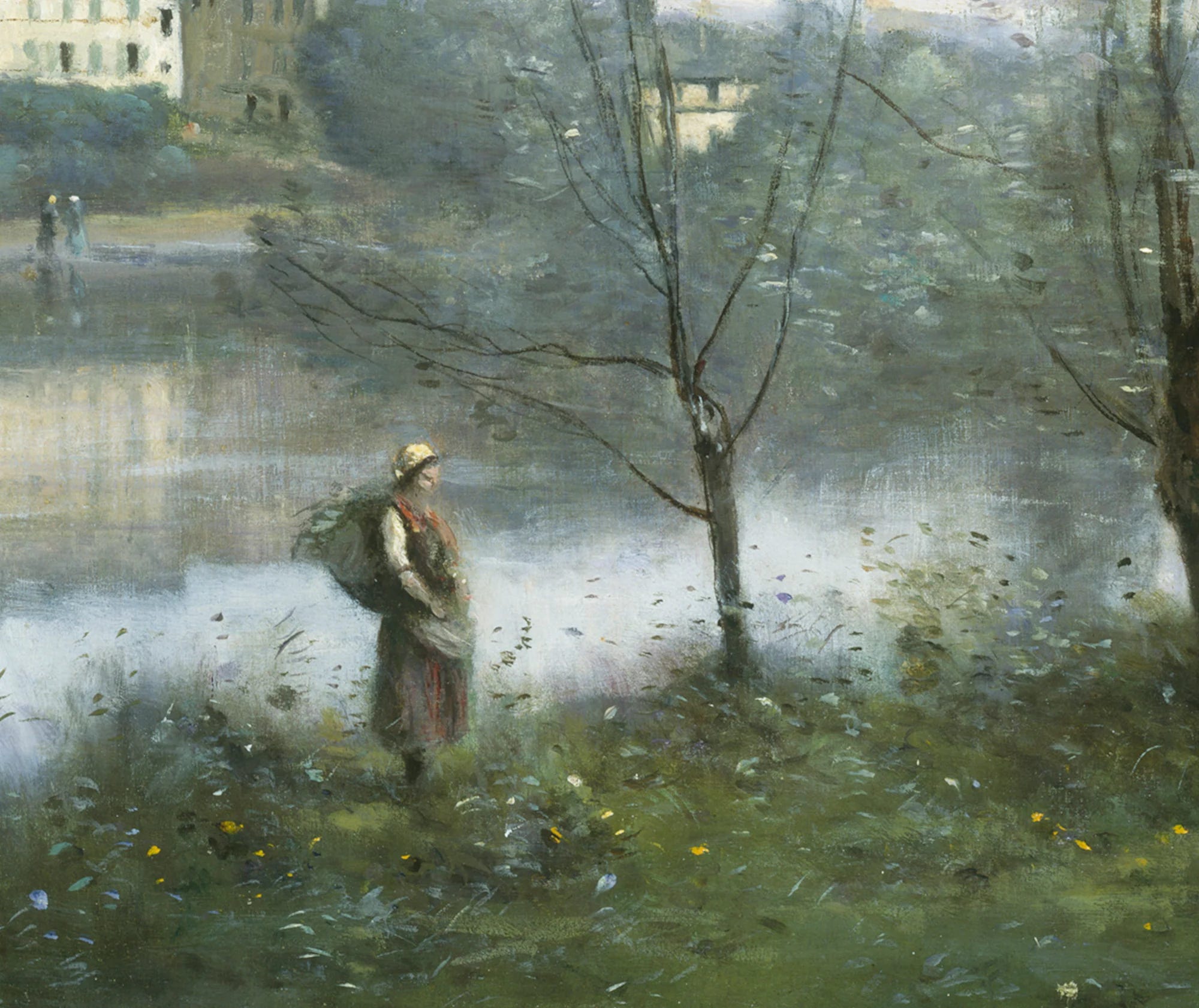
A Woman Gathering Faggots at Ville-d’Avray, c.1871–74. Oil on canvas. 72.1 × 57.2 cm. The Metropolitan Museum of Art, New York.
The edge of the pond at Ville-d’Avray, the place Corot loved throughout his life. A solitary woman carrying firewood walks along the water. Again, a staffage figure.
What demands attention is the silvery-gray tonality. According to the Metropolitan Museum, this distinctive silver-tinted tone may reflect the influence of photography — the new medium then spreading through society. The blurred outlines of the trees in the foreground resemble the effect of moving leaves as captured by nineteenth-century cameras.
Here again is light as condition. The air is thinly, evenly bright — and asserts nothing. Beautiful, but staying within the comfort zone.
Light as Condition — The Ceiling That Beauty Builds
Let us look back at the painters considered elsewhere in this series. Church exaggerated light — painting columns that could not exist in nature in order to prove light’s very presence. Turner dissolved form in his pursuit of light. Friedrich made light absent, lodging its meaning within silence.
Corot’s light has none of that will. The air has been brightened by the sun — that is all. Light is condition, atmosphere, the material of poetry. There is no question in it, no wager, no challenge. It stays within the comfort zone.
And that is precisely why it is beautiful. Anyone can feel it as beautiful. And that is precisely why it has a ceiling.
Two Critics, One Truth
Corot’s contemporaries saw his essence clearly — and reached opposite conclusions.
The critic Théophile Thoré wrote: “Corot has only a single octave, extremely limited and in a minor key. A musician would say he knows scarcely more than a single time of day — morning — and a single color — pale gray.”
Baudelaire offered the opposite verdict, and meant it as praise: “Corot is not a colorist — he is a harmonist.”
Both critics are looking at the same quality. One octave, one register. Thoré called it a limitation; Baudelaire called it harmony. Staying within the comfort zone was read by one as absence, by the other as completion.
The question is not which critic was right. The fact that standing before the same painting, two minds arrived at such opposite words — that itself tells us everything about what kind of painter Corot was.
AI Comparative Analysis: What If Van Gogh Had Painted This Scene?
What happens when the same composition is handed to a painter who left the comfort zone entirely? We used AI to find out.
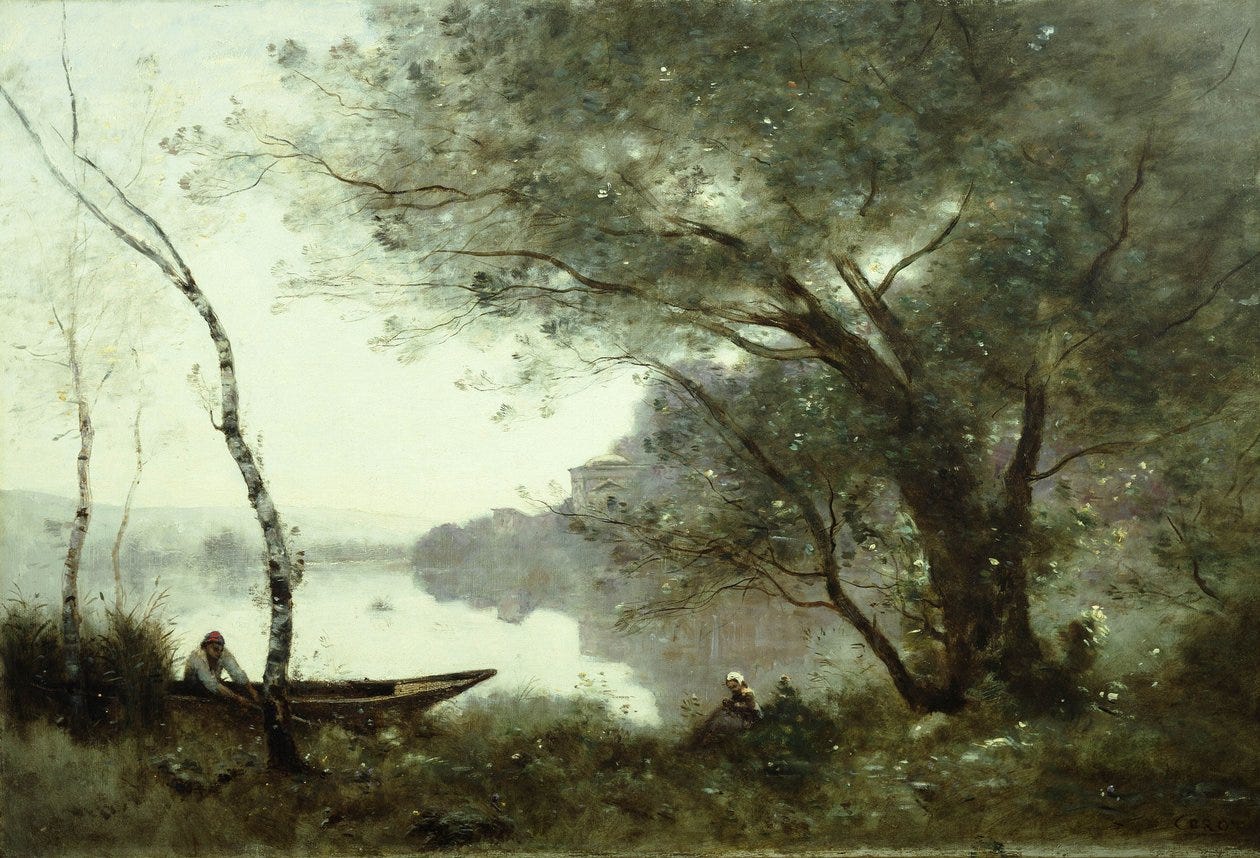
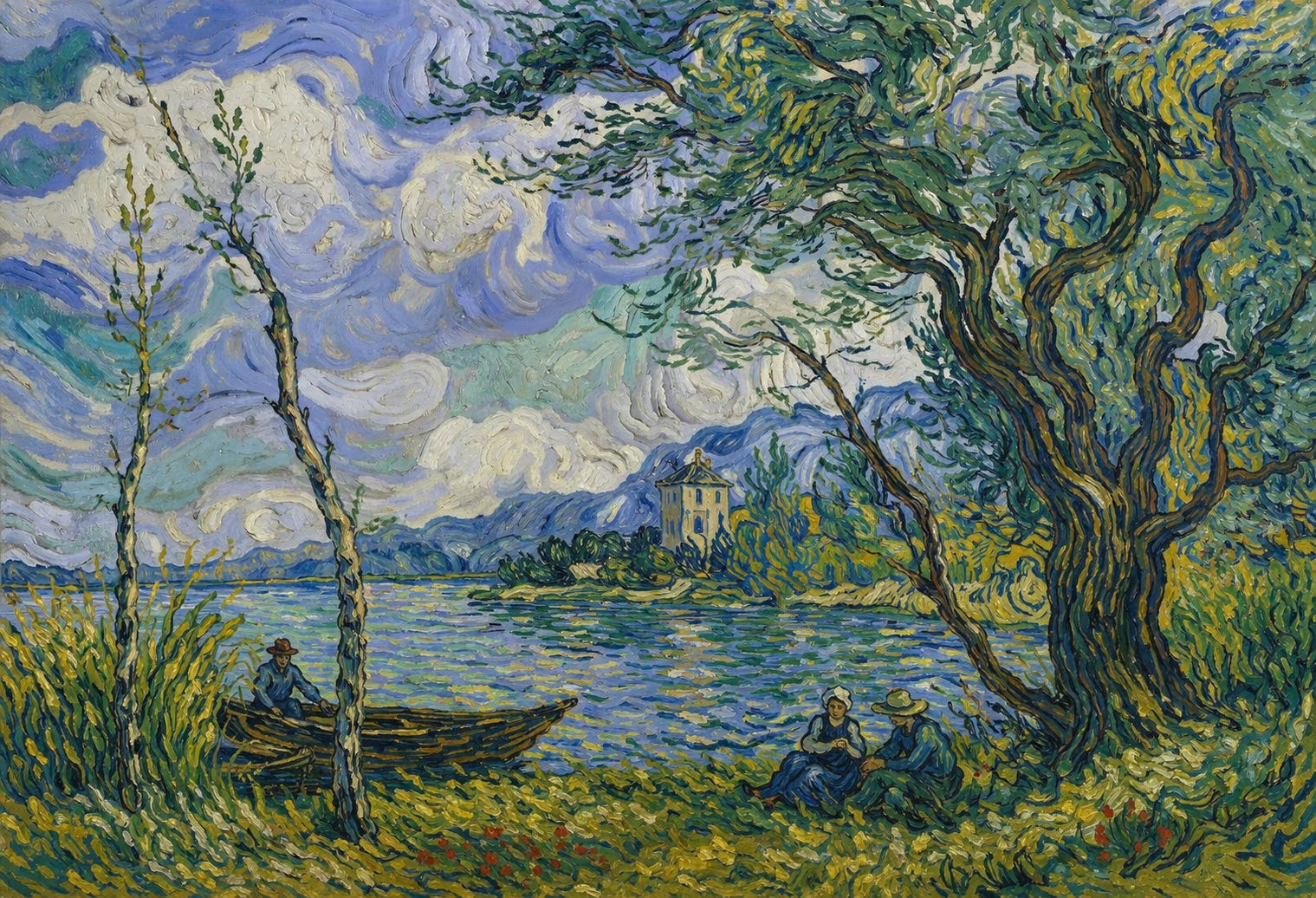
The composition is identical. The same trees, the same boat, the same figures, the same building across the water. Only the handling of light has changed.
But that change transforms the character of the painting from the ground up.
In Corot’s version, light was a condition. A silver-gray atmosphere fills everything equally; light comes from nowhere in particular and simply pervades the scene. The man in the boat and the figures on the bank exist without any relationship to the light — they are simply there.
The moment the scene is rendered in Van Gogh’s manner, light becomes emotion. The sky churns. The trees writhe. The water trembles with dense, directional strokes of blue and green. The figures on the bank are no longer staffage. They become beings caught inside a storm of light — and they begin, irresistibly, to mean something.
This is the essential difference between light that stays within the comfort zone and light that steps outside it. Corot’s light enfolds the landscape. Van Gogh’s light cries out to it.
But there is a deeper point. Van Gogh would never have painted a composition like this in the first place. A balanced, harmonious, stable arrangement is itself already a declaration of comfort-zone thinking. It is not only the light — the composition too was Corot’s choice. Give Van Gogh a brush and the trees press against the frame, the horizon tilts, the figures are consumed by light. Stability was never part of the equation.
Van Gogh insisted he was painting what he saw. Some attribute his vision to a neurological condition; whatever the cause, his way of seeing was not that of ordinary perception. Corot, by contrast, stands at the far end of what any beginning painter might aspire to. The amateur who picks up a brush for the first time and thinks, I want to paint like that someday — they are thinking of Corot.
The difference is between a painting that stands on the side of the landscape, and a painting that stands on the side of the self.
To stay within the comfort zone may be to paint without ever leaving the landscape behind.
This, perhaps, is what it means to be the Forgettable of the Unforgettable. — among world famous paintings.