
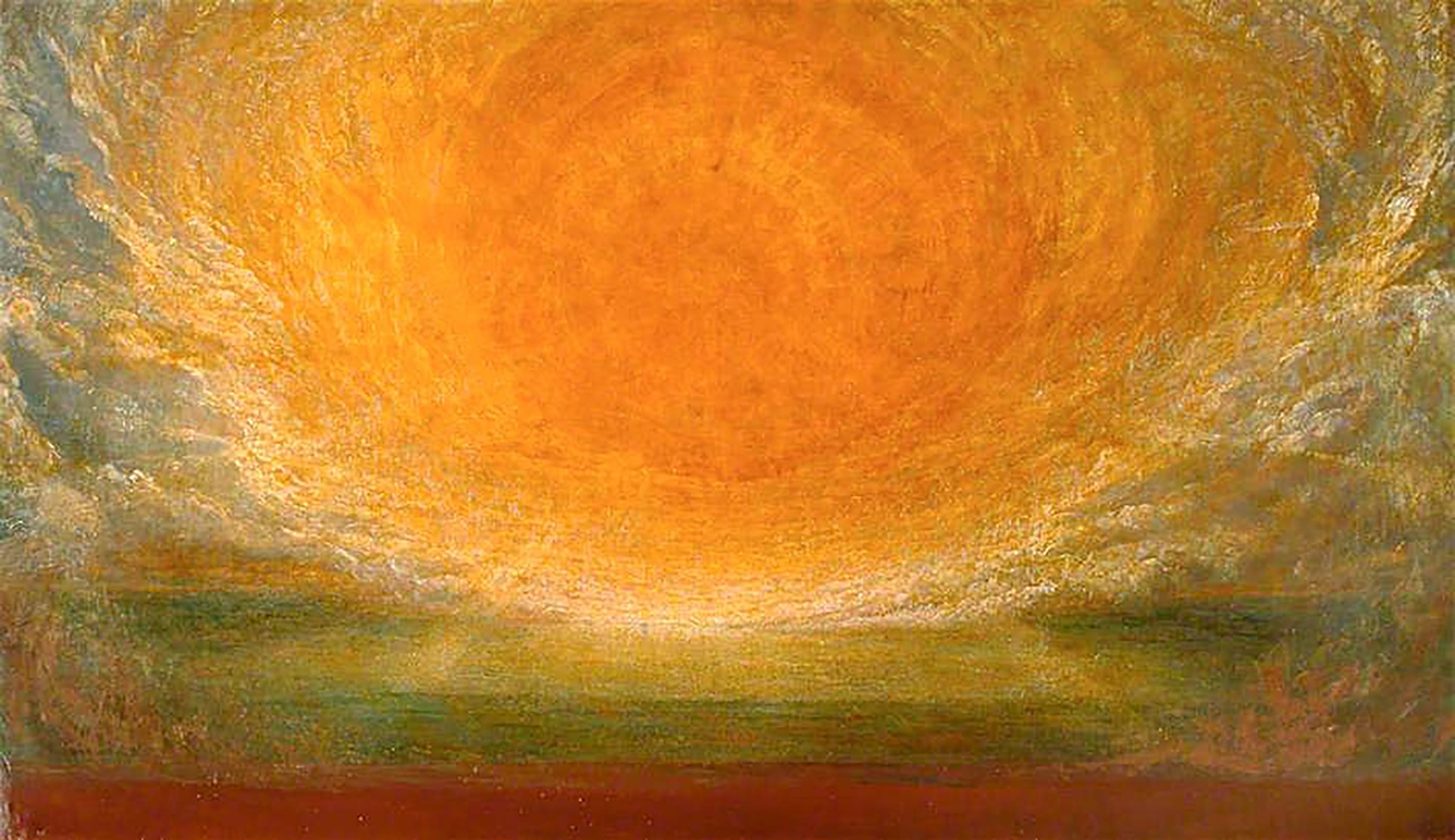
When painting the story of Noah’s Flood, a painter has a set of reliable symbols at hand. A dove, an olive branch, Mount Ararat, the ark — place these in the composition and any viewer will immediately recognize the scene. For those who know the Bible, these symbols work with certainty.
Watts discarded all of them.
The only thing he placed in the painting was the sun. Without reading the title, no one would know this depicts the aftermath of Noah’s Flood. Watts knew this — and did it anyway.
Why? Paint with biblical symbols, and the painting reaches only those who know the Bible. But the flood has ended, and light has returned — the meaning of that moment reaches beyond scripture. For every people, every culture, the return of light after darkness is a symbol of survival. Watts was not painting the story of Noah. He was painting the fact that humanity continues to exist. That is the universal light.
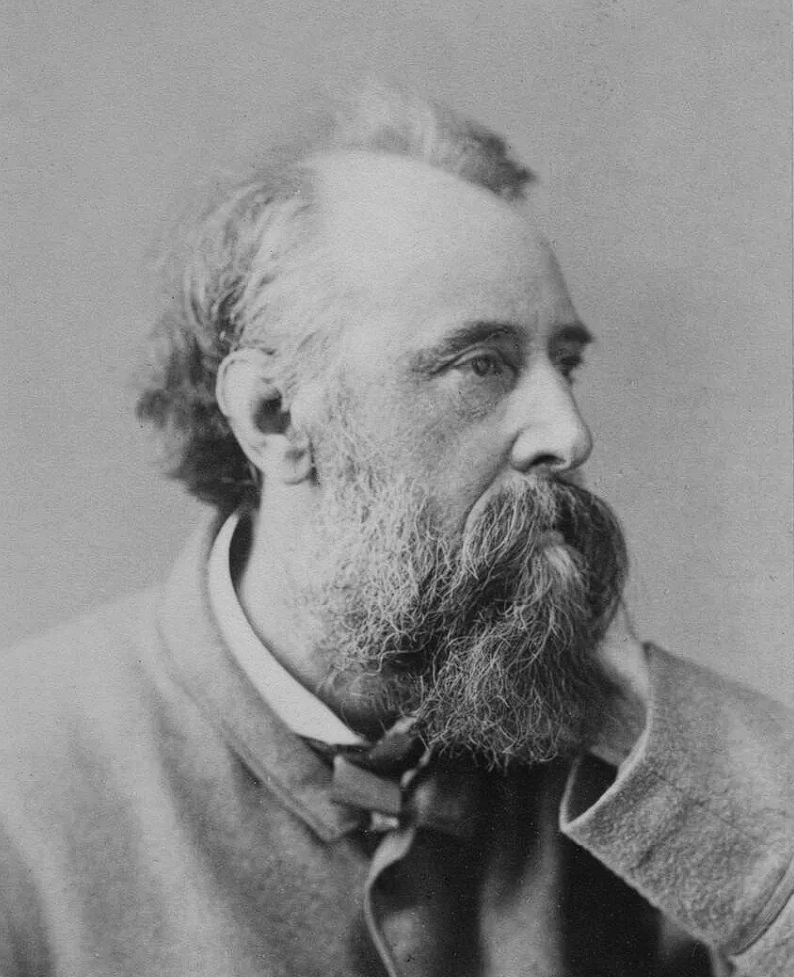
A Painter Who Spoke Honestly in One Work Alone
George Frederic Watts (1817–1904) was one of the most representative painters of the Victorian era. Known for his “Hall of Fame” series — portraits of more than fifty distinguished figures including Gladstone, Tennyson, and J.S. Mill — he was among the most sought-after portrait painters of his age.
Yet Watts himself held portraiture in contempt. “I paint ideas, not things” — these were his words. Portraiture was work done for a living; what he truly wished to paint were allegorical and symbolic works.
In one sense, the structure of his career resembles Picasso’s. Picasso too painted sellable portraits in his early years, and the shift to Cubism became possible only after economic security was established. Watts similarly painted portraits to survive while continuing to paint what he truly wished to paint. There is, however, one difference. Watts’s portraits are technically accomplished but stylistically conservative; his challenges to convention were concentrated in specific works.
One such work — the singular point of challenge — was The Morning after the Deluge.
Watts established a unique position as a leading figure of Victorian Symbolism. Where the Impressionists pursued the fleeting effects of light and color in the moment, Watts sought to express eternity and universality through symbol. His only work in which light itself became the explicit subject was this painting. Throughout a lifetime of portraits and allegories, he turned to face light directly just once.
Watts conceived his allegorical works as part of a grand symbolic cycle he called the “House of Life” — an ambitious, lifelong project to express all the emotions and aspirations of human existence in a universal symbolic language.
The Light That Needed No Story
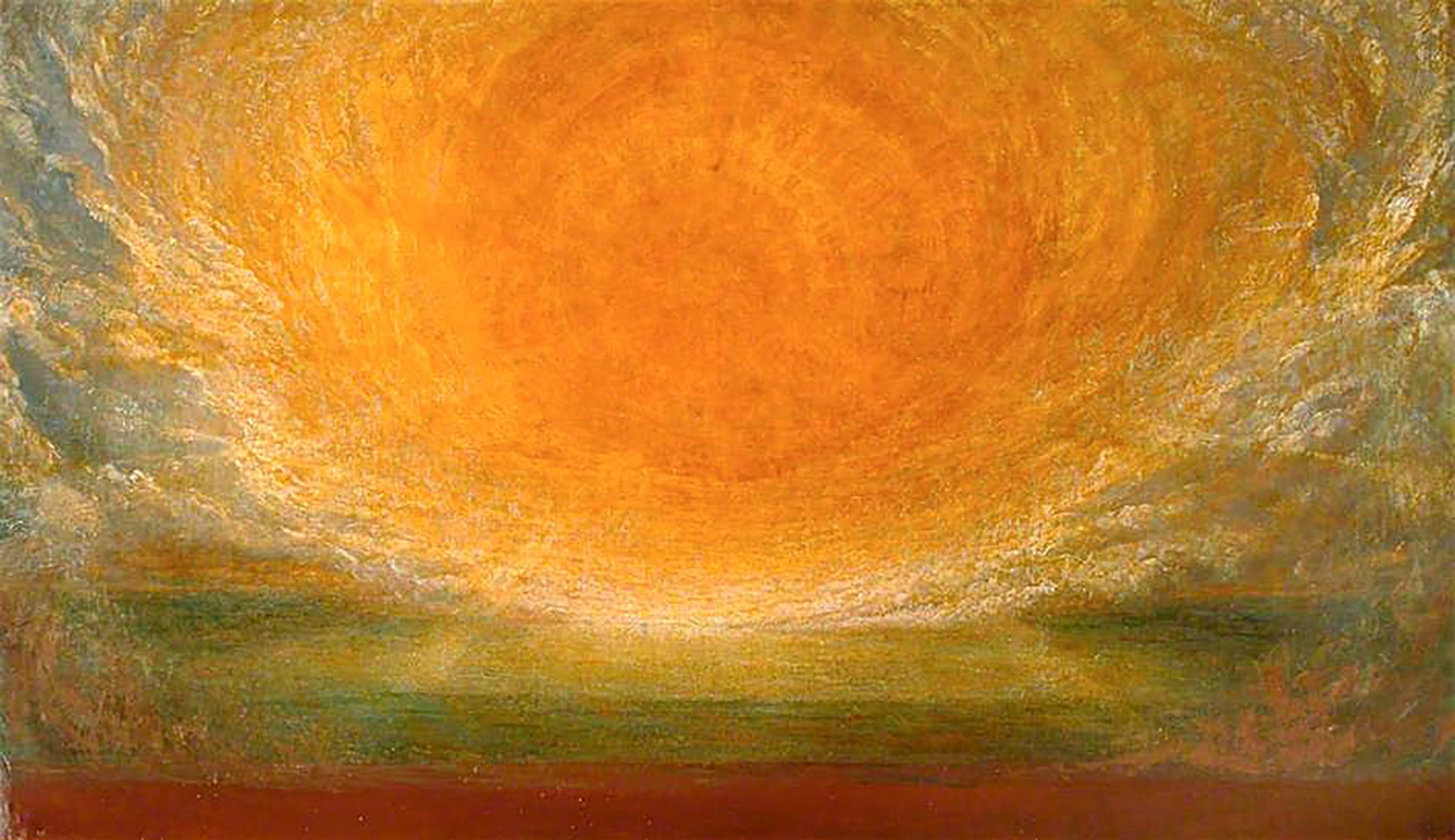
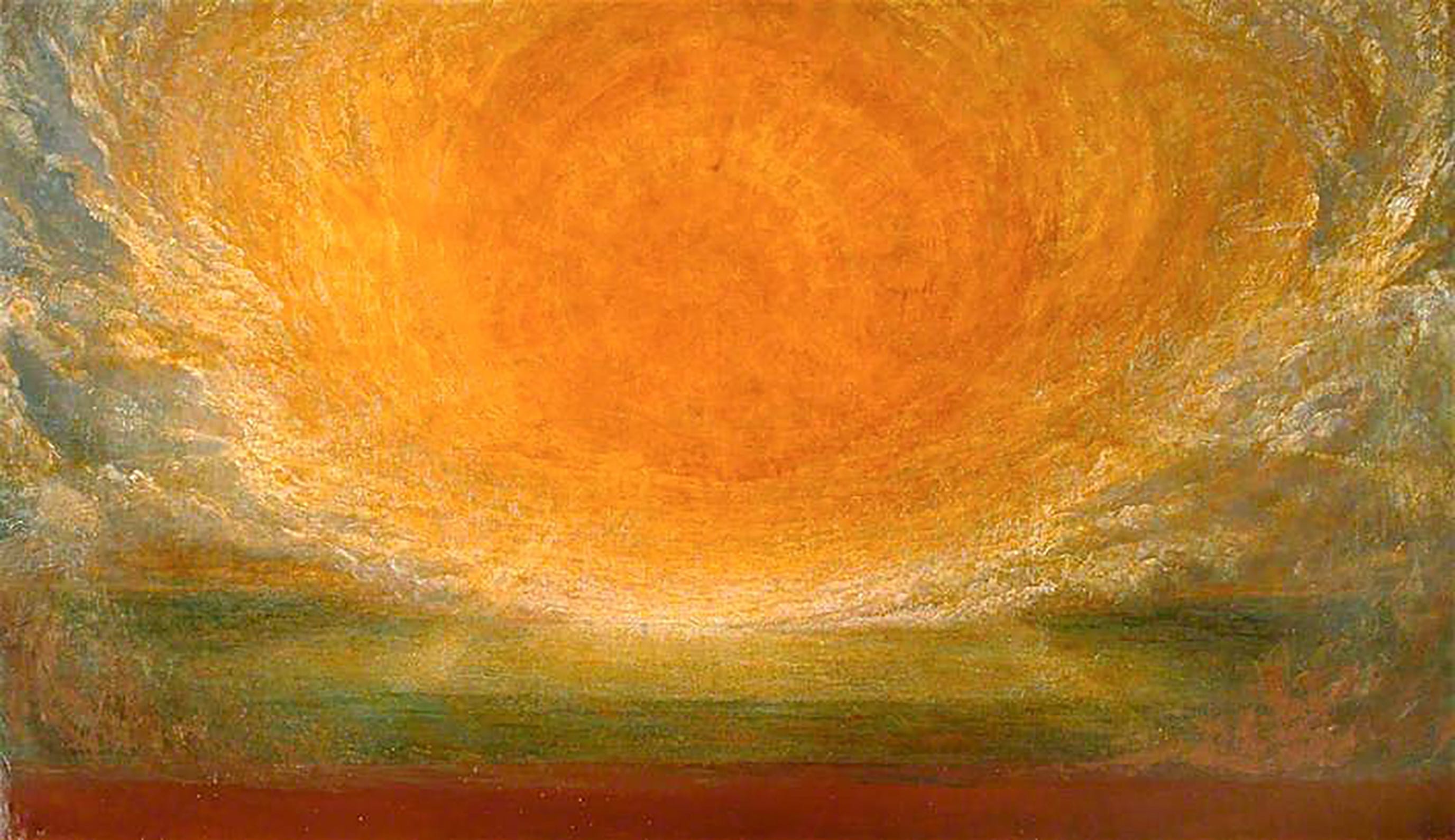
The Morning after the Deluge (The Forty-First Day), 1843. Oil on canvas. Tate Britain, London.
At the center of the canvas is the sun. Below it, a surface of water stretches out, and the sun’s reflection fills the entire painting with light. That is all.
No mountain. No dove. No olive branch. No ark. There is not a single element by which this painting can be identified as a depiction of Noah’s Flood. Only after reading the title does one understand that this is the forty-first day — the morning after forty days and forty nights of rain had finally ceased.
Why did Watts eliminate every symbol?
The dove, the olive branch, the ark — these are evidence of a Christian narrative. To include them is to make the painting into a story. But what Watts wished to paint was not a story. The flood has ended, and light has returned — the human longing for survival in that moment, the elemental joy at the return of light — these are sensations that reach even those who have never read the Bible.
By discarding the symbols, Watts freed this painting from the Christian narrative. By leaving only the sun — the most universal of all light — he sought to make a painting that could reach human beings of every culture and every age.
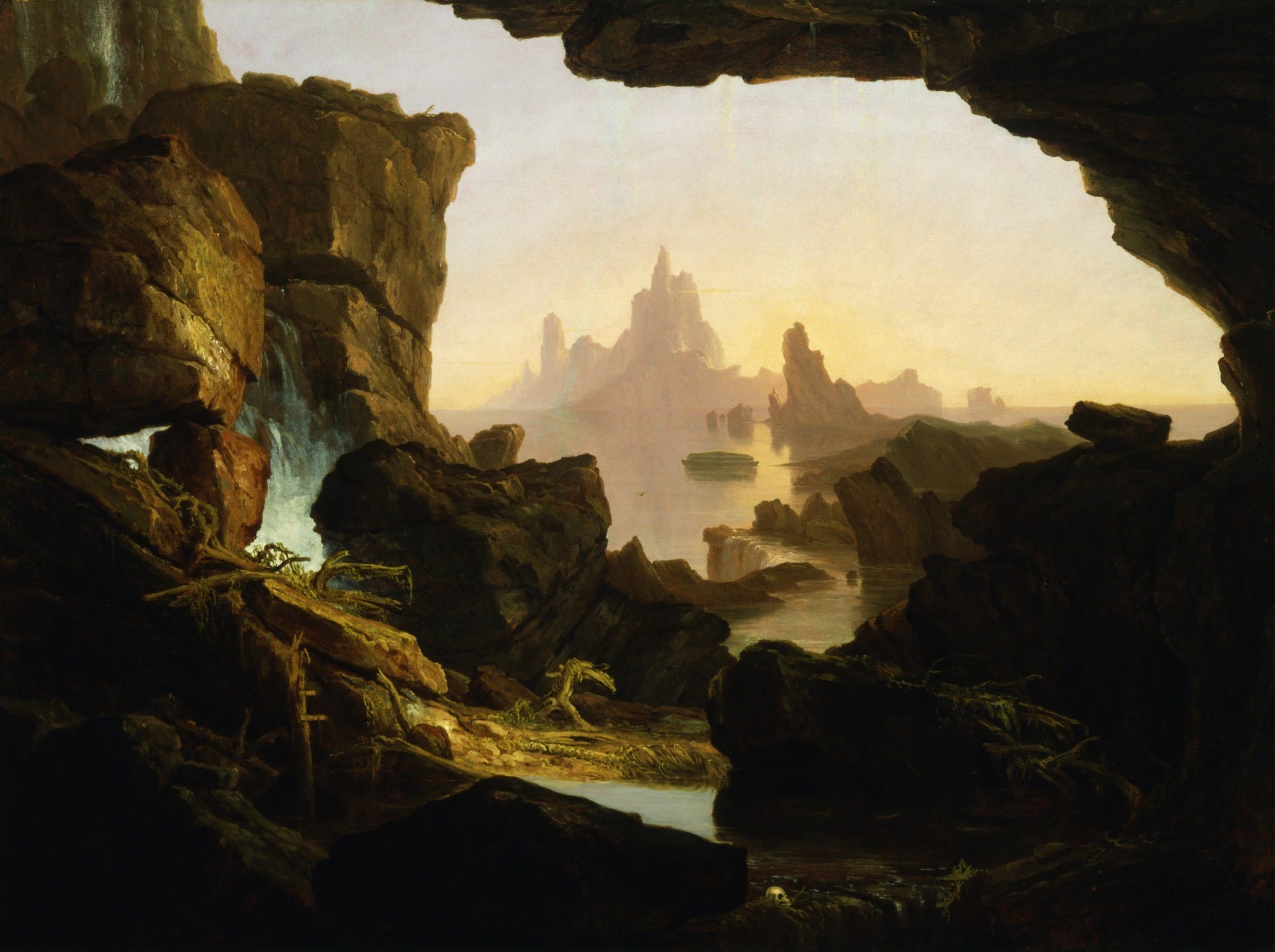
The Subsiding of the Waters of the Deluge, 1829. Thomas Cole. Smithsonian American Art Museum, Washington D.C.
Thomas Cole was the defining figure of the American Hudson River School and the teacher of Church. In this work, the vast landscape after the receding of the flood is depicted. In the foreground, rocky ground begins to emerge from the water; in the distance, mountains are wrapped in mist. Light begins to break through the sky, and the silence and renewal after the storm are palpable.
Cole here bound the biblical narrative of Noah’s Flood to the American vision of sublime nature. The light is rendered purely as a natural phenomenon — the sky after the storm — and remains positioned within the context of the story. Placed beside Watts’s painting, the difference in the role of light becomes sharply apparent. Cole’s light is the backdrop of a narrative. Watts’s light is the subject itself.
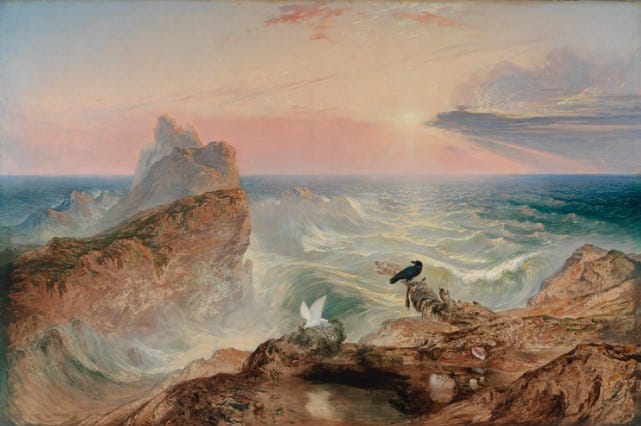
The Assuaging of the Waters, 1840. John Martin. Tate Britain, London.
John Martin was a British painter known for historical and religious works of vast scale. In this painting, an immense expanse of water stretches to the horizon, and the peaks of mountains barely emerge in the distance. Dramatic light breaks through the sky, and the tension of the moment when the storm is passing is palpable.
Like Cole, Martin places the evidence of narrative within the composition. The mountains, the scale of the water, the dramatic staging of light in the sky — these are all symbols functioning within the context of Noah’s Flood. The viewer reads the painting by confirming each one: that scene.
Watts, Cole, Martin — placing the three side by side, three approaches to the same subject become visible. Cole and Martin painted the story. Watts attempted to transcend it.
The Same Year, The Same Subject — Turner and Watts
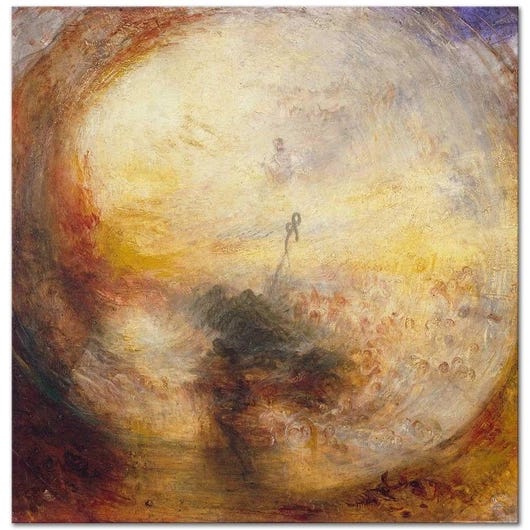
Light and Colour (Goethe’s Theory) — The Morning after the Deluge — Moses Writing the Book of Genesis, 1843. Oil on canvas. 78.7 × 78.7 cm. Tate Britain, London.
Turner painted his Morning after the Deluge in 1843 — the same year as Watts. Two painters, the same subject, the same year.
In Turner’s painting, within a swirl of golden and red light, something resembling a human figure and something resembling a white angelic form barely survive. Form has nearly dissolved — but not entirely. For Turner, light was a phenomenon of color; in pursuing it, form gradually melted away, but the last trace of a human presence was retained.
In Watts’s painting, there is no human figure at all. Only the sun.
Where does this difference come from?
Turner was a painter who achieved fame early. Even in landscape commissions from landowners and aristocrats, he was able to paint in his own manner — dissolving form, bringing light and color to the foreground. The freedom to paint as he wished was granted to him at an early stage of his career.
Watts’s situation was different. In portrait commissions, he was required to subordinate his own approach. What patrons wanted was a likeness, and there was no room to introduce symbol or universality. The burning desire to paint what he truly wished to paint was, in Watts’s case, more acutely felt.
It may have been that desire — so long suppressed — that drove him to discard every symbol and place only the sun: to reach toward a universality that could transcend scripture. Standing before Turner’s painting alongside Watts’s, one cannot help but think so.
Turner dissolved light into color. Watts discarded all form and left only light. The same year, the same subject — and yet two paintings of light born from entirely different lives.
AI Comparative Analysis: What Is Lost When the Symbols Are Added?
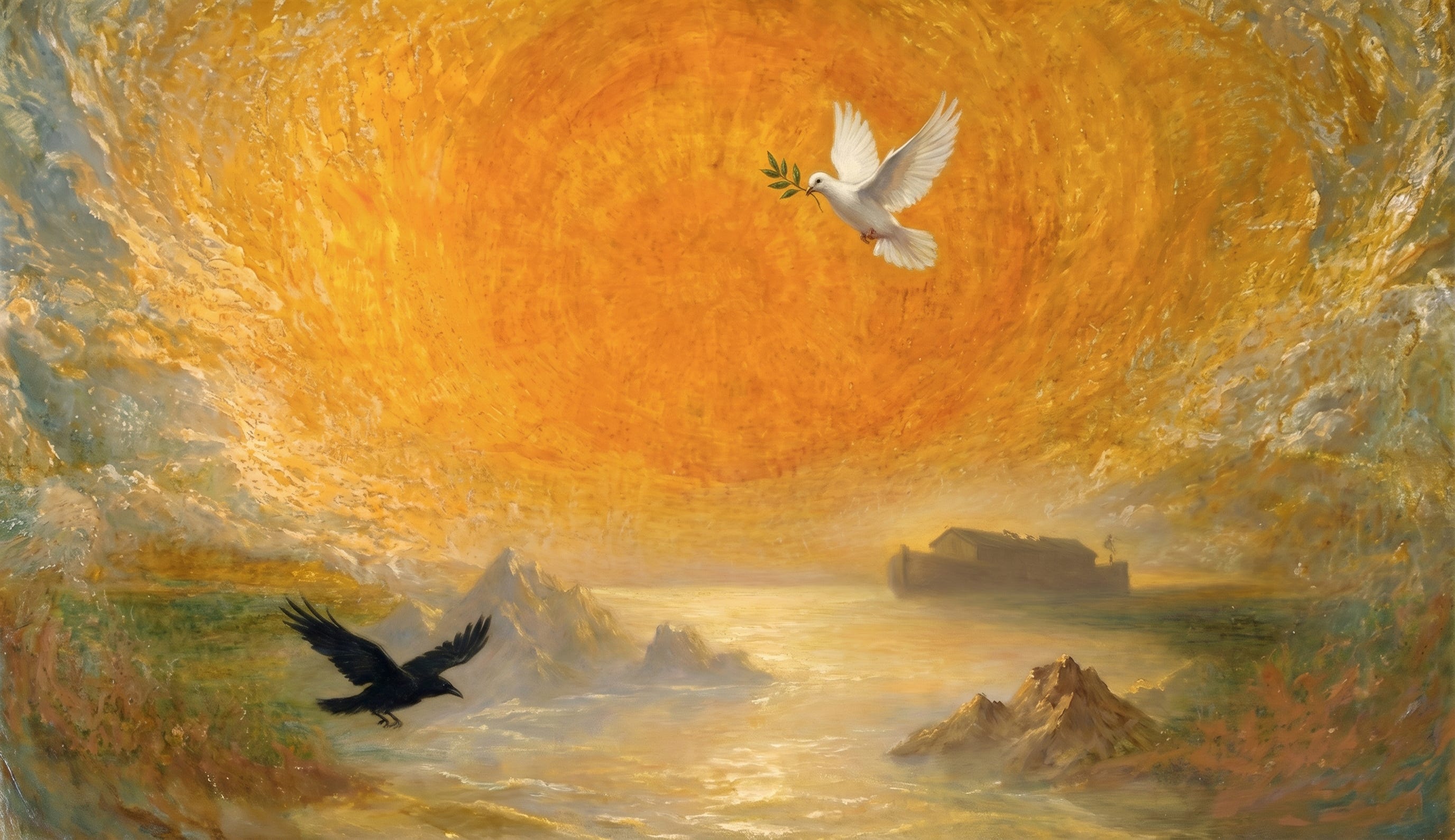
Keeping the same pictorial style, a dove, olive branch, raven, mountaintop, and ark were added.
The painting changes immediately. It becomes explanatory. It becomes didactic. The AI placed the designated symbols faithfully — and in that moment, the painting’s range of thought was confined. It became a book illustration.
The viewer sees the dove and thinks: symbol of peace. Sees the ark and thinks: Noah. Sees the raven and thinks: the ground has not yet appeared. Attention is absorbed in reading the symbols, and the reason to stand still before the painting is lost.
This was not what Watts wished to paint. The grand theme carried by the light of the sun — humanity’s longing to continue existing, the elemental fact that light returns after darkness — cannot be conveyed through symbols. Symbols were the enemy of universality.
Only the sun remains. That alone is enough for the return of light to reach any human being — those who have never read the Bible, those from entirely different cultures — as an elemental joy. This comparison makes visible, at a glance, why Watts discarded every symbol.