
What made Utrillo stand out?
Some people look at the same landscape and see something entirely different.
On the hill of Montmartre, painters have always gathered to capture the city for tourists. At the turn of the twentieth century, one name emerged from among the countless artists working in that same place: Maurice Utrillo. His subject matter was the ordinary streets of Paris — the same streets everyone else was painting. Yet Utrillo alone made the ordinary look like nothing else.
Why did Utrillo capture such devotion — enough to earn him the Légion d’honneur? That is the question this article sets out to answer.
A Painter Saved by Painting
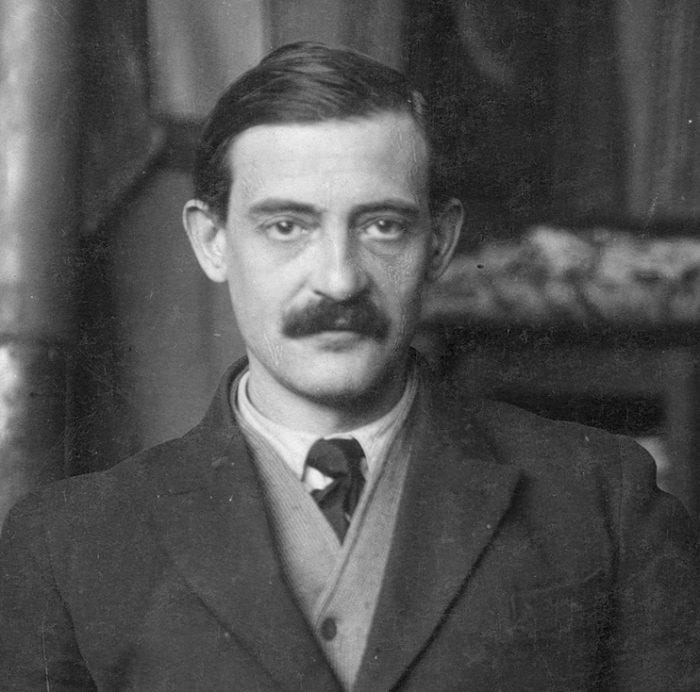
Maurice Utrillo (1883–1955) was born in Montmartre, Paris. His father was never identified. His mother, Suzanne Valadon, was both a painter and a celebrated model for Renoir and others. Raised in a turbulent household marked by constant upheaval, Utrillo spent much of his childhood shuttled between boarding schools, and long stretches were left to the care of his grandmother. Loneliness and anxiety were simply the texture of his early life.
In his late teens he developed a severe alcohol dependency and was hospitalized. It was a psychiatrist who first suggested painting as part of his recovery. Unable to work outdoors, Utrillo painted from postcards and photographs in his room, depicting the streets of Montmartre he knew intimately. With almost no formal training, he developed his craft rapidly, and by 1909 he was exhibiting at the Salon d’Automne.
Around 1910, a distinctive shift took hold: white and grey became the dominant tones of his canvases. This body of work would later be called his White Period — the years in which his singular voice is most fully heard. Utrillo mixed zinc white with plaster to recreate the texture of Montmartre’s aging walls. He painted streets without people. He painted buildings without drama. And yet these canvases spoke directly to something in the viewer that more accomplished, more fashionable paintings did not reach.
Utrillo has been called the best-selling painter in France. In his later years he was awarded the Légion d’honneur. He returned to Catholicism with deep devotion, married Lucie Valore in 1935, and moved to Le Vésinet outside Paris. Fame never freed him from alcoholism or mental illness. He painted the streets of Paris until the end. The question of why those streets, in his hands, became something irreplaceable — the answer lies in how he handled light.
The White Period: When Buildings Began to Glow
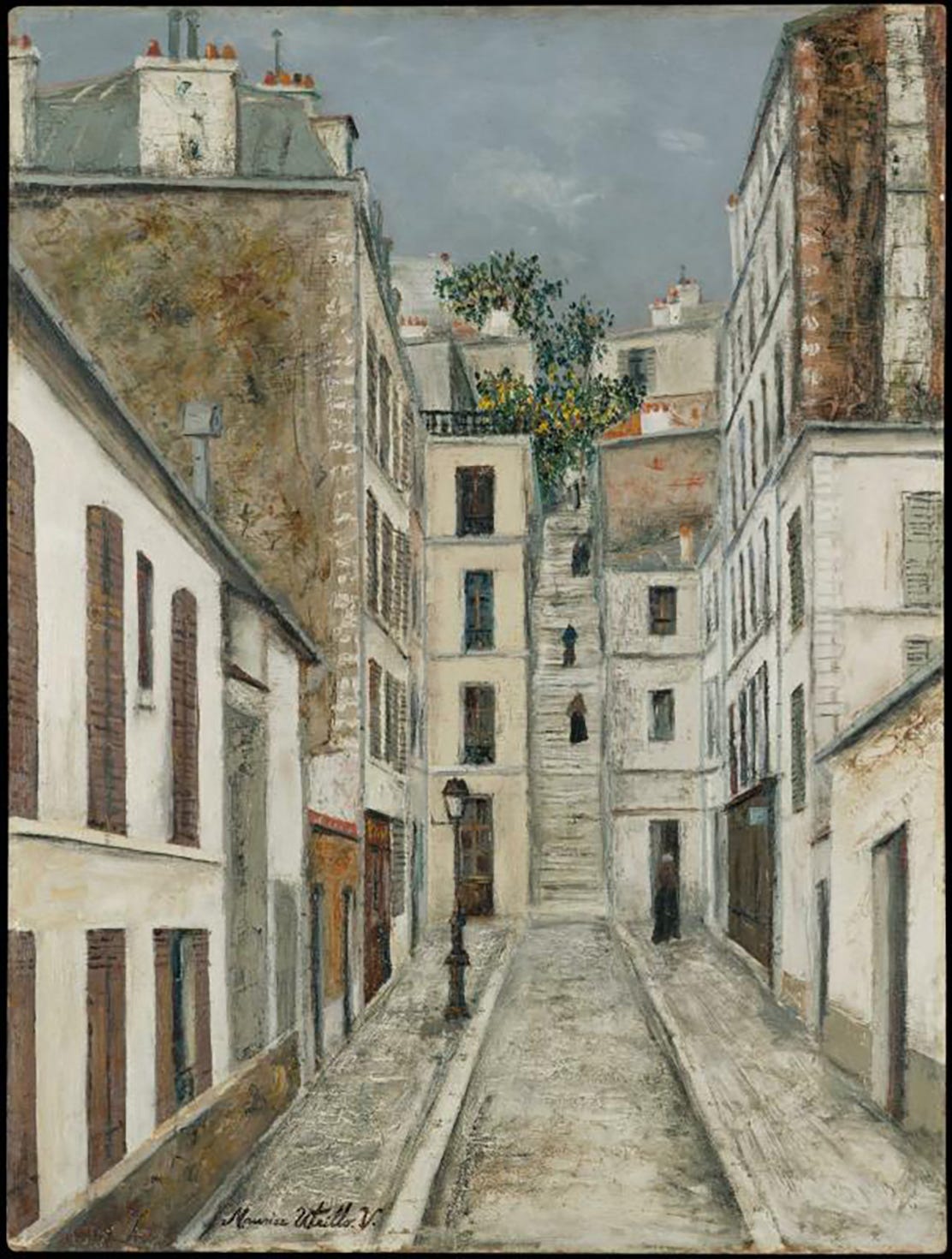
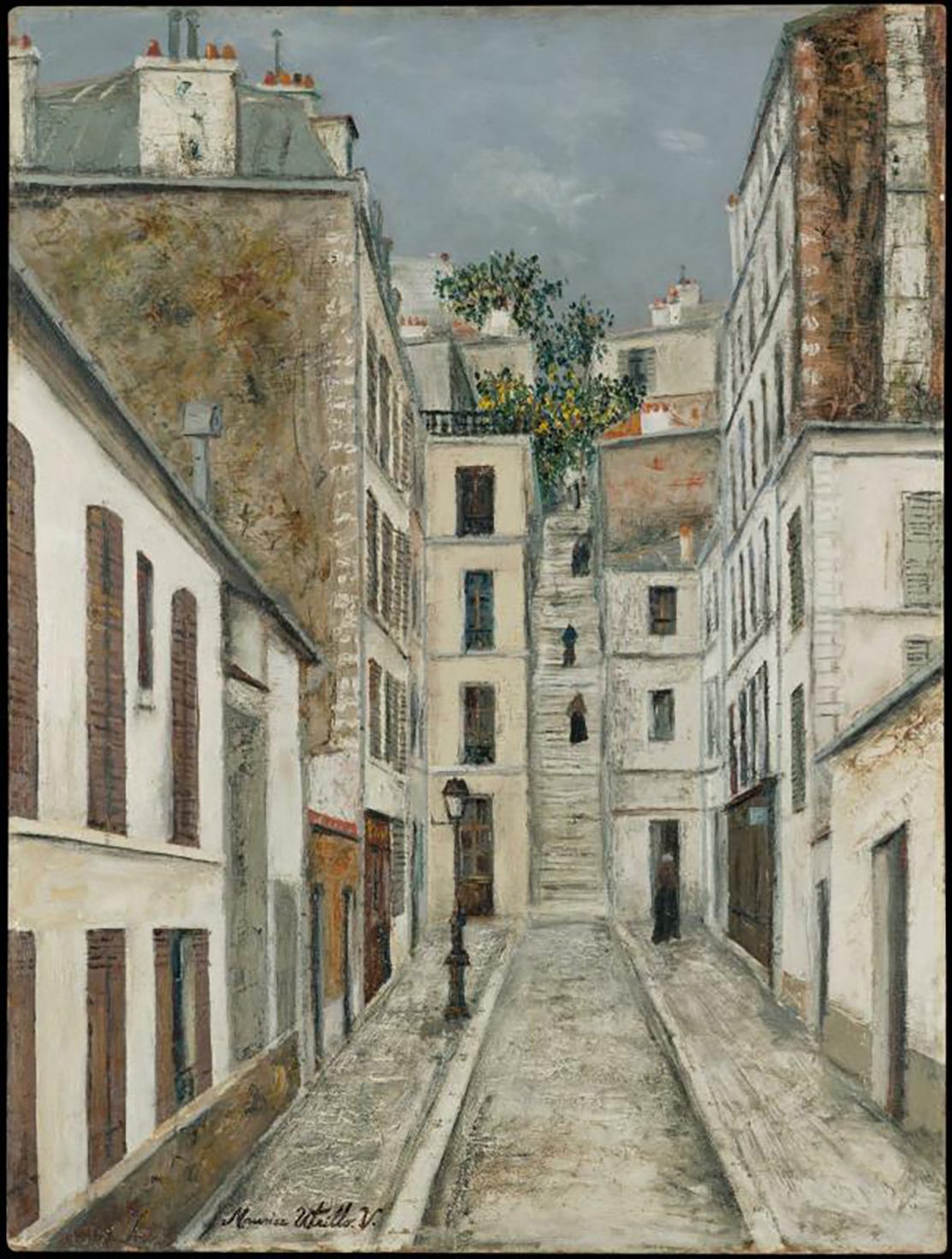
L'Impasse Cottin (c. 1910–11). Oil on canvas. Centre Pompidou, Paris.
In Utrillo’s White Period paintings, figures are almost entirely absent. Look closely, and something else is also missing: shade and shadow. Neither the gradation of a surface in partial light, nor the cast shadow of one object upon another, appears in these works. Yet the paintings never feel flat. The reason lies in the surfaces themselves — walls whose texture and color shift almost imperceptibly, outlines that are straight but never rigid, a quiet organic tremor running through the entire picture plane.
His handling of light is categorically different from that of other painters. Where most artists depict light by showing what it falls upon and what it leaves in darkness — contrasting illuminated surfaces against shadow — Utrillo paints as though the buildings themselves are the source of light. The result is a canvas that seems to radiate softly outward, toward the viewer.
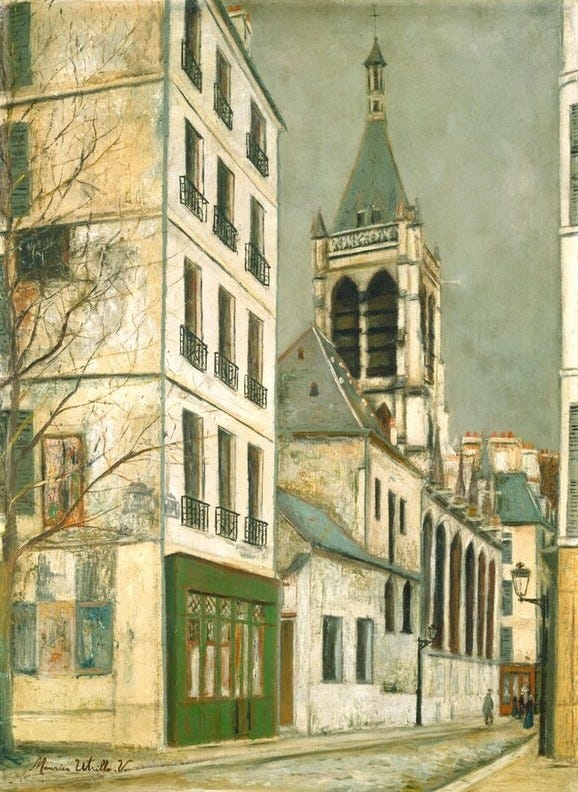
The Church of Saint-Séverin (c. 1913). Oil on canvas. National Gallery of Art, Washington D.C.
The same quality appears throughout the White Period. Here again, neither shade nor shadow is rendered. The light that would logically be reflected off the building’s surface is treated instead as if it originates there. The forms are organic, the surfaces alive with subtle variation — and an unremarkable urban scene lodges itself quietly in memory.
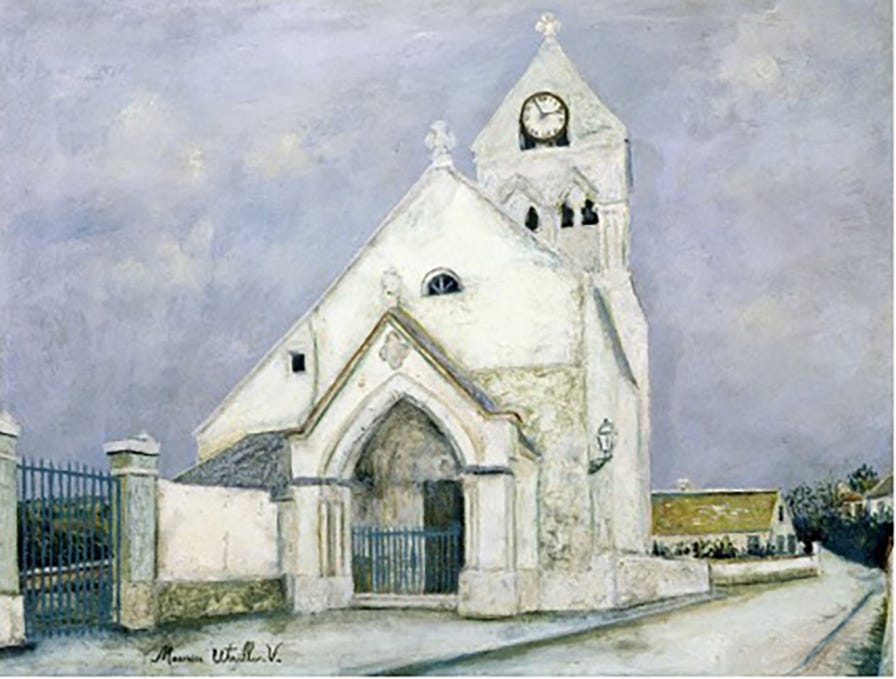
Church at Deuil (1912). Oil on canvas. Private collection.
The same principle governs this parish church in an ordinary town. A subject anyone could paint. Yet through Utrillo’s hand, the building becomes a thing that harbors light — not receives it. This is the sensibility that lifted him above the many.
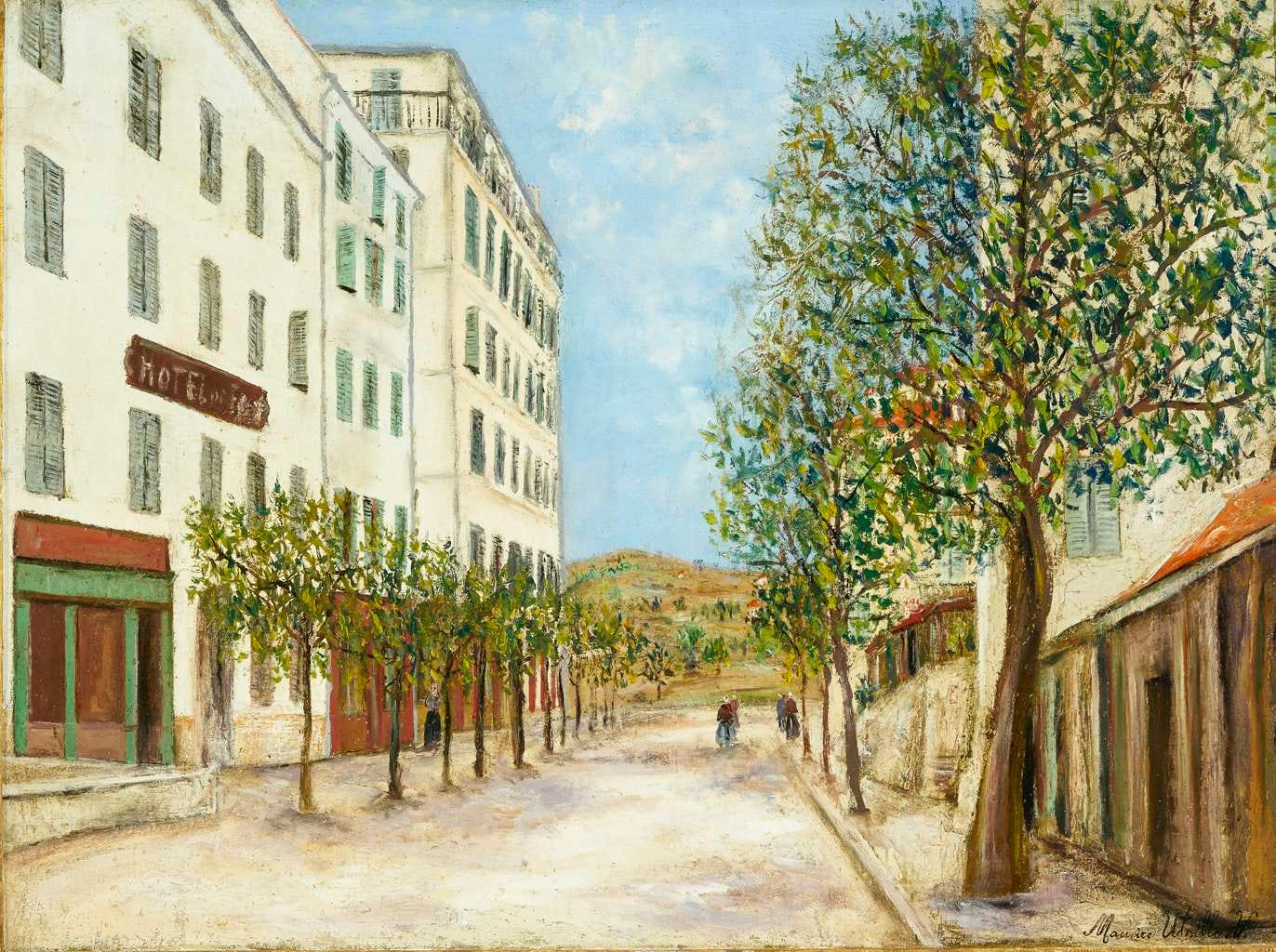
Rue à Corte, Corse (c. 1913–14). Oil on canvas, 60 × 81 cm. Private collection.
This is the town of Corte on the island of Corsica, painted during a journey Utrillo made in autumn 1913 with his mother Suzanne Valadon and André Utter. Human figures appear only as distant specks. There is nothing conventionally animated about the scene — and yet no sense of desolation reaches the viewer. Why not? The answer is the same.
Three Elements That Gave Buildings Life
Why do Utrillo’s unpeopled paintings resist melancholy? Three structural elements account for it.
First: the surfaces of his buildings carry texture and color — organic, varied, alive. Second: his outlines, though largely straight, carry a subtle irregularity — never the hard edge of an inert object. Third: he does not paint shadows.
These might seem like incidental choices. In isolation, none of them sounds like the foundation of greatness. But together, they produce something that transcends their sum. The buildings breathe. They appear to generate their own warmth. They speak — not loudly, but persistently — as though the walls themselves have something to say.
This is what separated Utrillo from the countless painters of Montmartre who surrounded him.
AI Comparative Analysis: What If three elements were not adapted?
What happens when these three elements are removed? What if the spell Utrillo cast on his buildings were deliberately broken — the walls made inert, the shadows restored, the lines made sharp? Using generative AI, I ran the experiment.
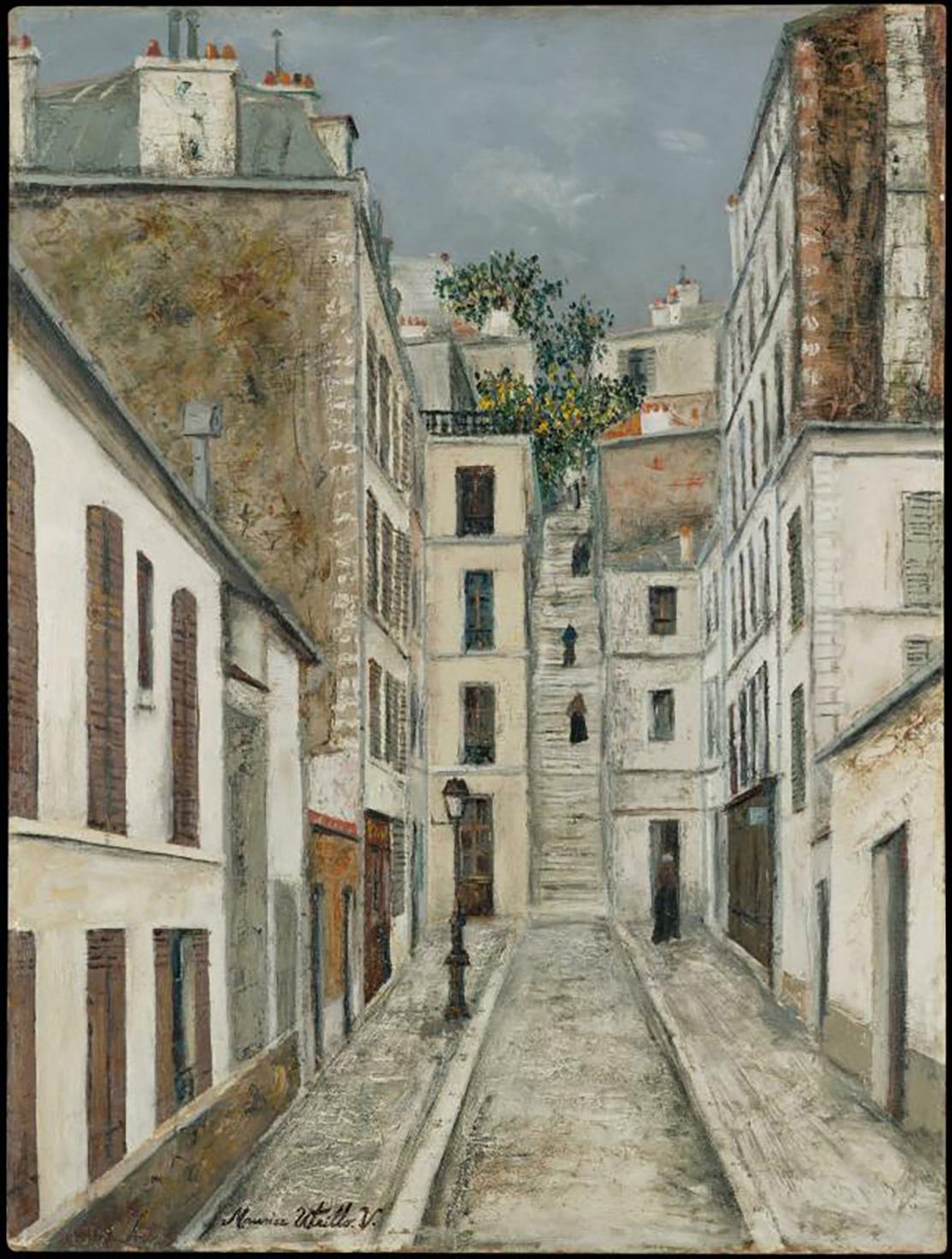
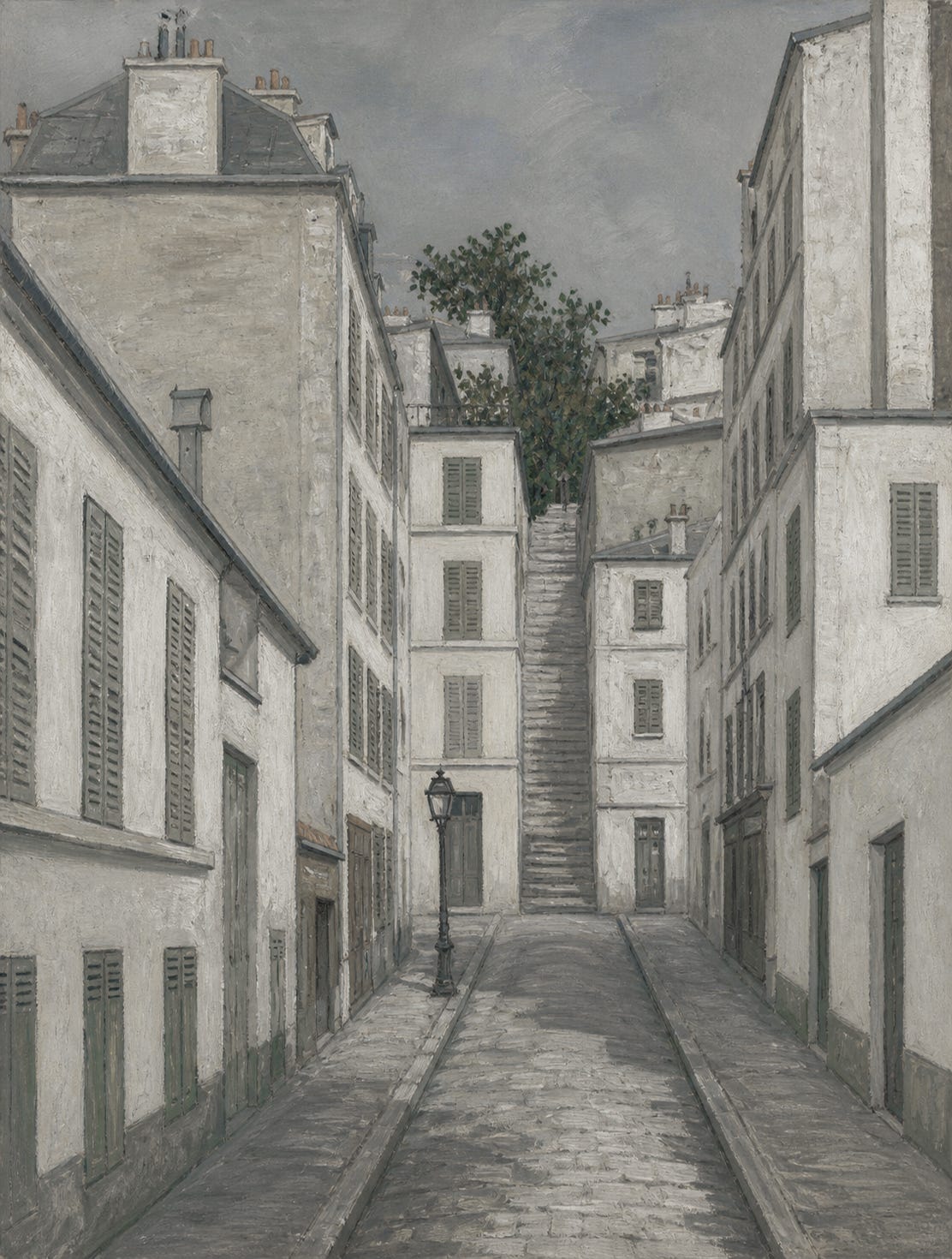
Contrasting Image
The difference is immediate. When comparing Utrillo’s work to an AI-generated reconstruction, the streets of Montmartre lose their vitality. The warmth drains from the walls. What remains in the AI’s rendition is a ghost town — a place where no one has ever lived, a realm of true desolation.
Utrillo’s paintings also contain almost no people. Yet they feel inhabited. The reason, the experiment makes clear, is that the buildings embodied the living things that were absent. Organic wall surfaces, gently irregular outlines — these are what make a building feel like a living thing.
However, it is the third element — the absence of shadow — that works differently, and more profoundly.
”No Shadow” Was Intentional
When shadows are painted, a building becomes a passive object: something that receives light and casts it elsewhere, subordinate to its environment. But when shadows are absent, the building appears to be the source of light itself — an active presence, illuminating its surroundings rather than being illuminated by them. This is what gives Utrillo’s architecture its life.
Utrillo knew where the shadows would fall. Whether working from postcards or from observation, the geometry was available to him. He chose not to use it. That choice — to withhold the shadow — was the choice that gave the building a soul.
After seeing the AI-generated image — stripped of all three elements — return to Utrillo. You will see that the buildings are alive in a way you may not have noticed before. They are not cold structures; they are “lighthouses of light” placed within a dark era or a lonely heart.
The Secret Hidden in Plain Sight
The streets Utrillo painted were ordinary. The buildings were ordinary. The technique, by the standards of his time, was considered rough. None of it should have worked.
And yet the buildings breathe. They hold warmth. They look back.
What people sought in Utrillo’s paintings was not a shared sense of loneliness. They sought to touch the overwhelming warmth and the “loquacity of life” that dwelt within the cold stone streets. These buildings were not physical objects pushing the viewer away; they were active, comforting presences.
This is the secret hidden in plain sight that previous critics failed to explain. It is why Maurice Utrillo became the most popular painter of the early 20th century.
The Power of Preconception
For over a century, Utrillo’s paintings have been described with words like “solitude” and “desolation” — a reflex reaction to the simple fact that his streets contain no people. Critics inherited the mental block set by their predecessors and never thought to question it.
In truth, people do not willingly purchase paintings that offer nothing but desolation. Compare Utrillo’s work to the sterile emptiness generated by AI imagery, and the warmth alive in his canvases becomes immediately apparent.
This was also a lesson in how thoroughly preconception dominates the mind — and how essential it is to break free from it.